


Indie, AAA, and AA Games: A Comparison
Ibrahim Nabeel
Assistant Manager - Game Taxonomy
@Gameopedia
Read Time :
4 Min
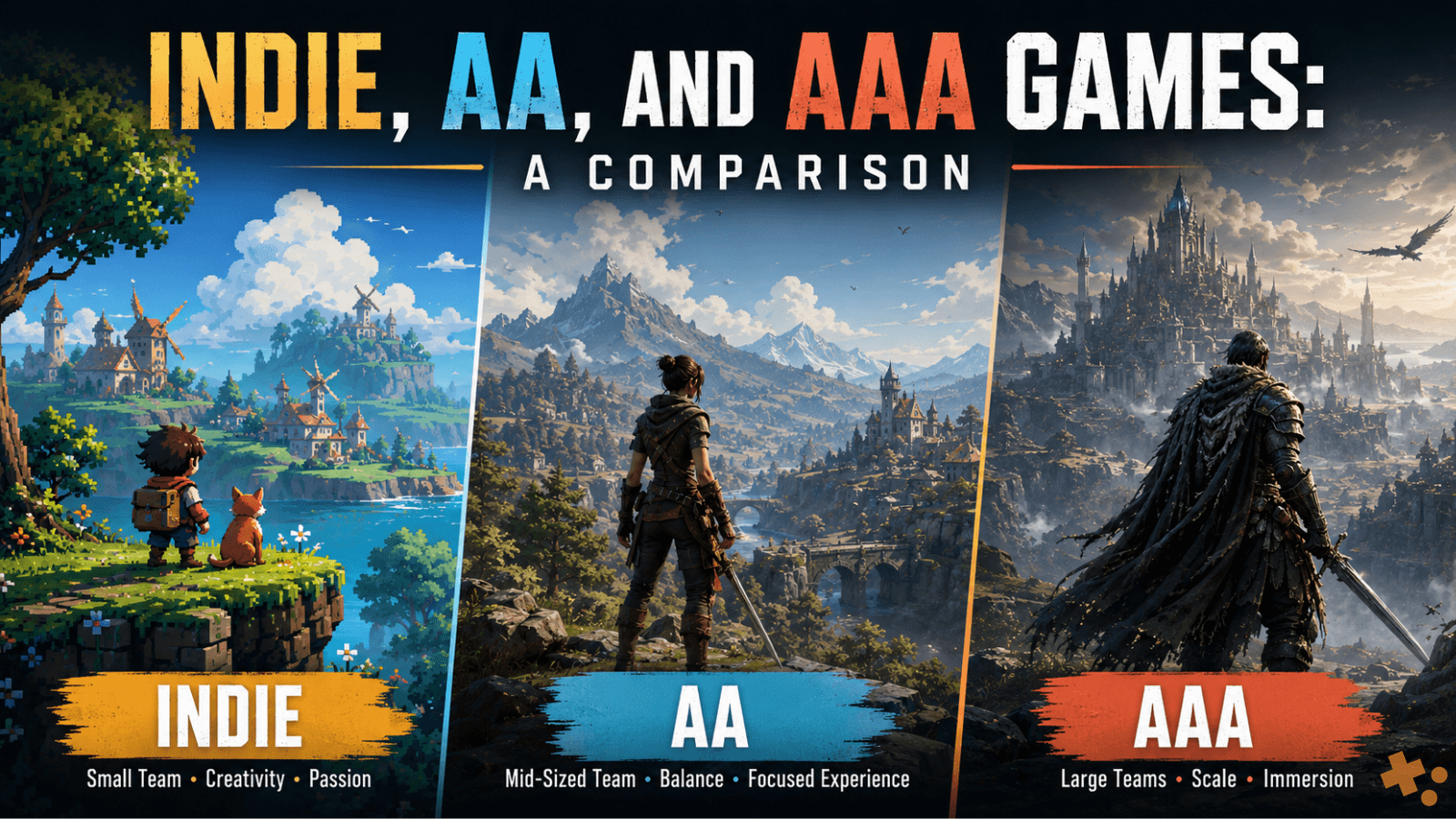
This blog consolidates the difference between the major classes of games—Indie, Double-A (AA), and Triple-A (AAA)—and explores how each game type targets its audience through different development approaches, budgets, and production values.
This article is for gamers, industry professionals, and anyone interested in understanding the differences between AA and AAA games. Knowing these differences helps players make informed choices and helps industry professionals navigate the evolving game market.
The video games industry generated almost $180 billion in 2020. In 2021, the video game market size in just the United States surpassed $85.86 billion. Video games, whether they are triple A games, indie, or AA titles, are important as a market for not just their significant revenue numbers but also for the value they create for the video game ecosystem.
Introduction to Game Development
The video game industry is a dynamic and multifaceted landscape, home to a wide spectrum of games ranging from small indie projects to blockbuster style AAA titles. These categories—indie games, AA games, and AAA games—are primarily distinguished by their development resources, including budget, team size, and production scale. The distinctions between indie, AA, and AAA games are primarily based on budget, team size, and production scale, with indie games being the smallest and most experimental, AA games being mid-tier, and AAA games being large-scale productions with significant resources. Indie games are typically created by small teams or even solo developers, often working with limited budgets and relying on creative problem-solving to bring their visions to life. In contrast, AA games are developed by medium sized teams with moderate budgets, striking a balance between ambition and resource constraints. At the top end, AAA games are produced by large companies with substantial financial backing, enabling them to assemble big teams and invest heavily in both development and marketing. Understanding these distinctions is crucial for anyone navigating the gaming world, as they influence not only the types of games available but also the experiences and innovations that shape the video game industry.
Next, we'll define each game class in more detail to clarify their unique characteristics.
Deciphering Indie, AAA, and AA Games in the Gaming Industry
While many find these informal yet effective definitions of benefit, game developers and publishers use them for marketing and to guide feature benchmarking and game mechanic analysis. Another group of people who use them extensively are e-retailers while categorizing game titles and pages, where managing video game information on e-commerce websites becomes crucial for accurate discovery and sales, underpinned by rich metadata for video games and quality game content that boosts discoverability for e-retailers that powers search, recommendations, and merchandising.
Let’s look at the basic definition for each before we head into the differences between them, keeping in mind the urgent need for a new game taxonomy that more precisely captures today’s complex titles and the role of market research for game studios during greenlighting as well as video game taxonomy that can transform game development.
Indie Games
Indie game stands for independent video game. Indie game companies are of two kinds. The first refers to the “independent” status of the company—they are not owned by a parent company that defines the company’s direction. The other refers to the small, self-funded nature of these companies.
Main characteristics:
Team size: Often less than ten people, sometimes just one person
Budget: Limited resources, often self-funded or crowdfunded
Creative freedom: High, with the ability to experiment with innovative and unique gameplay mechanics
Marketing approach: Relies on direct sales, crowdfunding, donations, and community engagement
This allows for more creative freedom, unique art styles, and the ability to experiment with innovative and unique gameplay mechanics. Indie games, with their independence and innovative focus, let developers take risks and explore new ideas, resulting in highly original games like Stardew Valley and Hades. In the indie game industry, studios usually depend on crowdfunding and donations to fund their games, even as broader video game industry challenges around content complexity and data and game discoverability issues that demand standardized data affect how these titles are discovered and managed. There are some highly successful indie studios who are financially stable but still produce smaller games. Examples of Indie games include Transistor, Minecraft, and Celeste.
AA Games
Also known as double A games, these are ambitious projects that occupy the mid-market tier. AA games are typically developed by teams of 50 to 100 people, with budgets ranging from $2 million to $10 million (sometimes up to $50 million). They balance quality and cost, offering more resources than indie games while maintaining a level of creative freedom that allows for experimentation and interesting ideas.
Main characteristics:
Team size: 50 to 100 people
Budget: $2 million to $10 million (sometimes up to $50 million)
Creative freedom: Moderate to high, allowing for experimentation and innovation, often targeting niche audiences
Marketing approach: More limited and targeted, relying on online campaigns and niche influencers
AA games offer more focused experiences and often innovate on gameplay mechanics. They often emphasize unique mechanics, storytelling, and a tightly designed experience, while AAA games offer high-fidelity visuals and massive cinematic scope designed for immediate mainstream appeal. While they may not have the massive scale of AAA titles, they frequently innovate on gameplay mechanics and deliver focused experiences. A representative example of a double A game is The Outer Worlds. Other examples include Life is Strange, A Plague Tale: Innocence, and Remember Me.
AAA Games
These are triple A (AAA) game titles made by AAA developers and AAA studios—large, well-funded companies capable of producing huge, blockbuster-style games. AAA games are produced or distributed by mid-sized to major publishers and involve big teams and large teams (development teams) often numbering in the hundreds, sometimes spread across multiple countries.
AAA games focus on massive scale, featuring expansive open worlds and high-fidelity graphics, while AA games offer more focused experiences and often innovate on gameplay mechanics.
Key features of AAA games:
Big budgets (often exceeding $100 million, sometimes reaching $200 million)
AAA production values
Cutting edge technology
Advanced graphics
Expansive open worlds
Cinematic sequences
High-quality voice acting (often featuring celebrity talent)
Extensive world building
Large development teams (hundreds of people, sometimes across multiple countries)
High marketing budgets and global campaigns
AAA development is characterized by these features, delivering massive scale, high-fidelity visuals, and a cinematic scope designed for immediate mainstream appeal. Studios tend to rely on established franchises and proven formulas, taking fewer creative risks to appeal to a broad target audience and minimize financial risk. Examples of blockbuster AAA titles include Final Fantasy VII (a groundbreaking title from the late 1990s that set new standards for production values and marketing), Red Dead Redemption, and The Witcher 3: Wild Hunt, all of which exemplify the ambition and polish of AAA games. AAA games often generate revenue through high sales volumes, downloadable content (DLCs), and microtransactions, while indie games typically rely on direct sales and optional donations.
With these definitions in mind, let's compare how these game classes differ in practice.
Comparing Indie, AA, and AAA Games
Let us look at how these game classes stack up against each other.
AA vs AAA Games: Direct Comparison Table
Factor | AAA Games | AA Games |
|---|---|---|
Budget | $100 million+ (often up to $200 million) | $5 million–$50 million (sometimes $2M–$10M) |
Team Size | Hundreds of people, often across countries | 50–100 people |
Production Values | High-fidelity visuals, cinematic sequences, advanced graphics, expansive open worlds | Focused experiences, unique mechanics, tightly designed gameplay |
Creative Freedom | Limited (focus on proven formulas, less risk-taking) | Moderate to high (more experimentation, niche genres) |
Marketing Approach | Large-scale, global campaigns, TV ads, influencer partnerships | Targeted online campaigns, niche influencers, limited marketing |
Risk-Taking | Low (rely on established franchises, minimize financial risk) | Higher (willing to innovate and take creative risks) |
Key Differences Between Game Classes
From the table above, you can see the notable characteristics of each game class as well as the key differences between them, which also shape video game genre trends among console games over time and can inform data-driven comparisons of game performance and audience segments, especially when grounded in a precise, mechanics-based video game genre taxonomy. This should be able to help you distinguish between AAA, AA, and Indie games.
With this blog we have tried to understand the characteristics of the different game classes and how they fit into the definitive database of video games, which is supported by advanced video game tagging and taxonomy services. We at
have specialized in collecting and curating game information about AAA, AA, and Indie game titles for the last 12 years and have been working with companies across the gaming ecosystem. From release dates, genres, and descriptions to in-depth game breakdowns and a robust genre taxonomy that powers game design and discovery, we strive towards providing the best to our clients. Reach out to us at sales@gameopedia.com to learn more about our offerings.
Next, let's explore how marketing and distribution strategies differ across these game classes.
Marketing and Distribution Strategies
Marketing and distribution approaches vary significantly between indie, AA, and AAA games, reflecting their differing resources and goals within the gaming industry and underscoring the importance of proven marketing launch playbooks for game releases, robust, gaming-native metadata that powers effective game discovery, and persona-driven discovery systems that optimize storefront recommendations.
AAA Marketing Strategies
AAA games, backed by large marketing budgets, often launch with high-profile campaigns that include television ads, influencer partnerships, and widespread social media promotion. These blockbuster titles are typically released across multiple platforms, with both digital and physical editions available to maximize reach and sales.
AA Marketing Approaches
AA games, while not matching the scale of AAA marketing, still employ targeted strategies—focusing on specific audiences, leveraging digital platforms, and sometimes utilizing niche influencers to build anticipation. Marketing for AA games is more limited and targeted, relying on online campaigns rather than big marketing blitzes.
Indie Game Promotion
Indie games, developed by smaller studios or solo creators with limited budgets, rely heavily on grassroots marketing tactics such as community engagement, social media buzz, and word-of-mouth recommendations. The rise of digital distribution platforms like Steam, GOG, and the App Store has been transformative, allowing indie developers to bypass traditional barriers and reach a global audience, even as online stores have fundamentally changed game discovery through metadata. While AAA and AA games benefit from more resources and broader distribution, digital platforms have leveled the playing field, enabling independent games to find success alongside high budget projects, particularly when supported by localized game metadata tailored to each eCommerce market.
25+ Years of playing Games with 7+ Years of Industry experience. A Gaming wizard also known as the wise one.