


How Gameopedia Curates the DNA of Games
Aleksander Kjeserud
Product Lead - Metadata & Taxonomy
@Gameopedia
Read Time :
10 minutes

Minecraft should be an easy game to classify.
It is one of the most well-known games in the world. Most people have a rough idea of what it is: you build, explore, mine, craft, survive, create, and play alone or with others. It sounds simple enough.
But when you look at how different platforms classify Minecraft, the simplicity disappears.
The App Store classifies it as an adventure game. Google Play describes it as casual, simulation, and sandbox. PlayStation classifies it as adventure, arcade, and unique. Xbox calls it action-adventure. Nintendo classifies it as action and simulation.
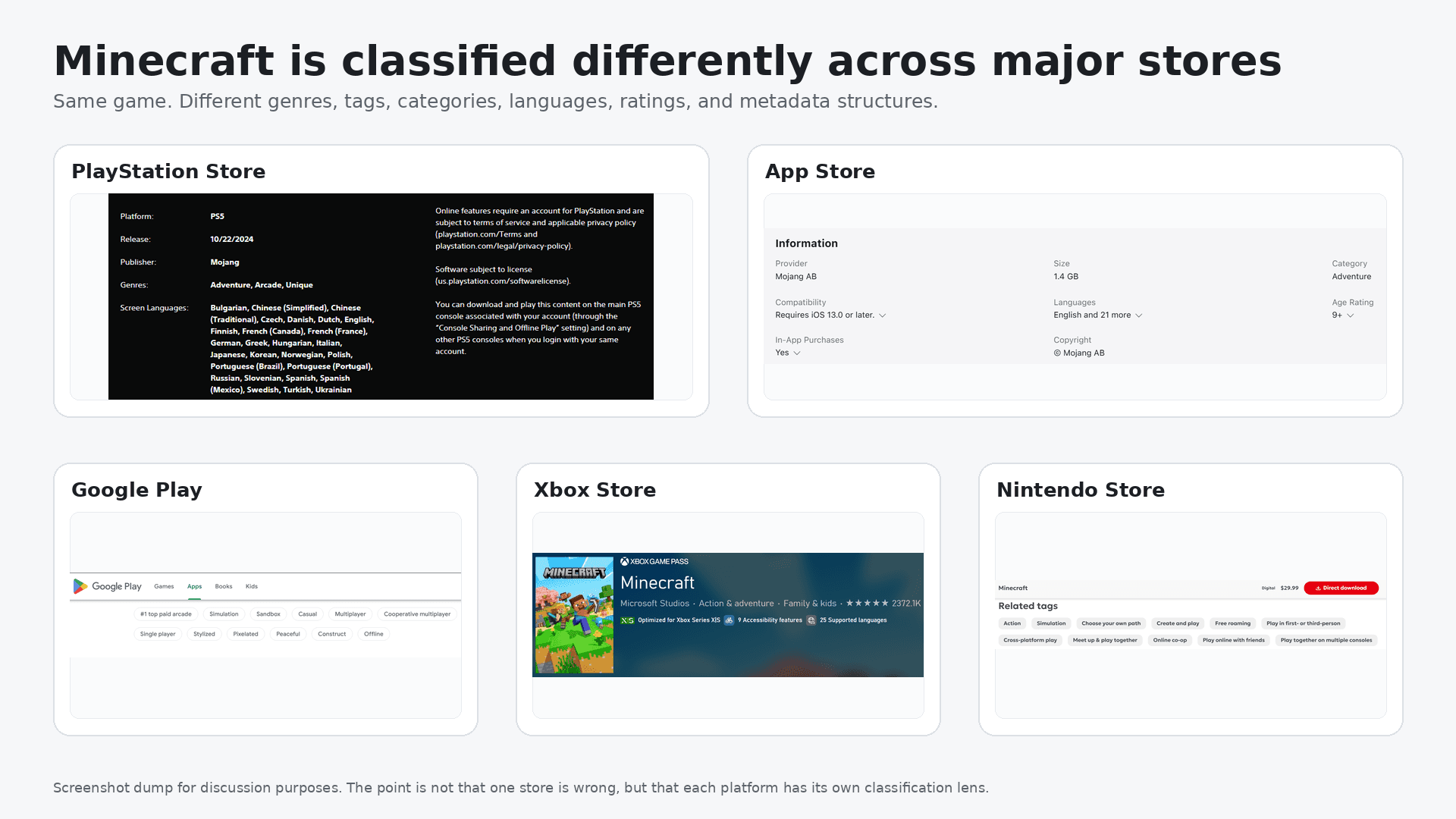
None of these labels are random. You can understand why each platform ended up there. Minecraft has adventure. It has action. It has sandbox play. It has systems. It has physics. It has creative freedom.
But that is exactly the problem.
If every platform applies its own interpretation, without shared definitions, the same game starts meaning different things in different systems. And once that happens, metadata stops being a reliable foundation for search, discovery, recommendations, analytics, AI, and advertising.
Take “simulation” as an example.
If a player is browsing for simulation games, are they expecting Minecraft to appear next to Football Manager, Euro Truck Simulator, Farming Simulator, Microsoft Flight Simulator, Satisfactory, Victoria, or Kerbal Space Program?
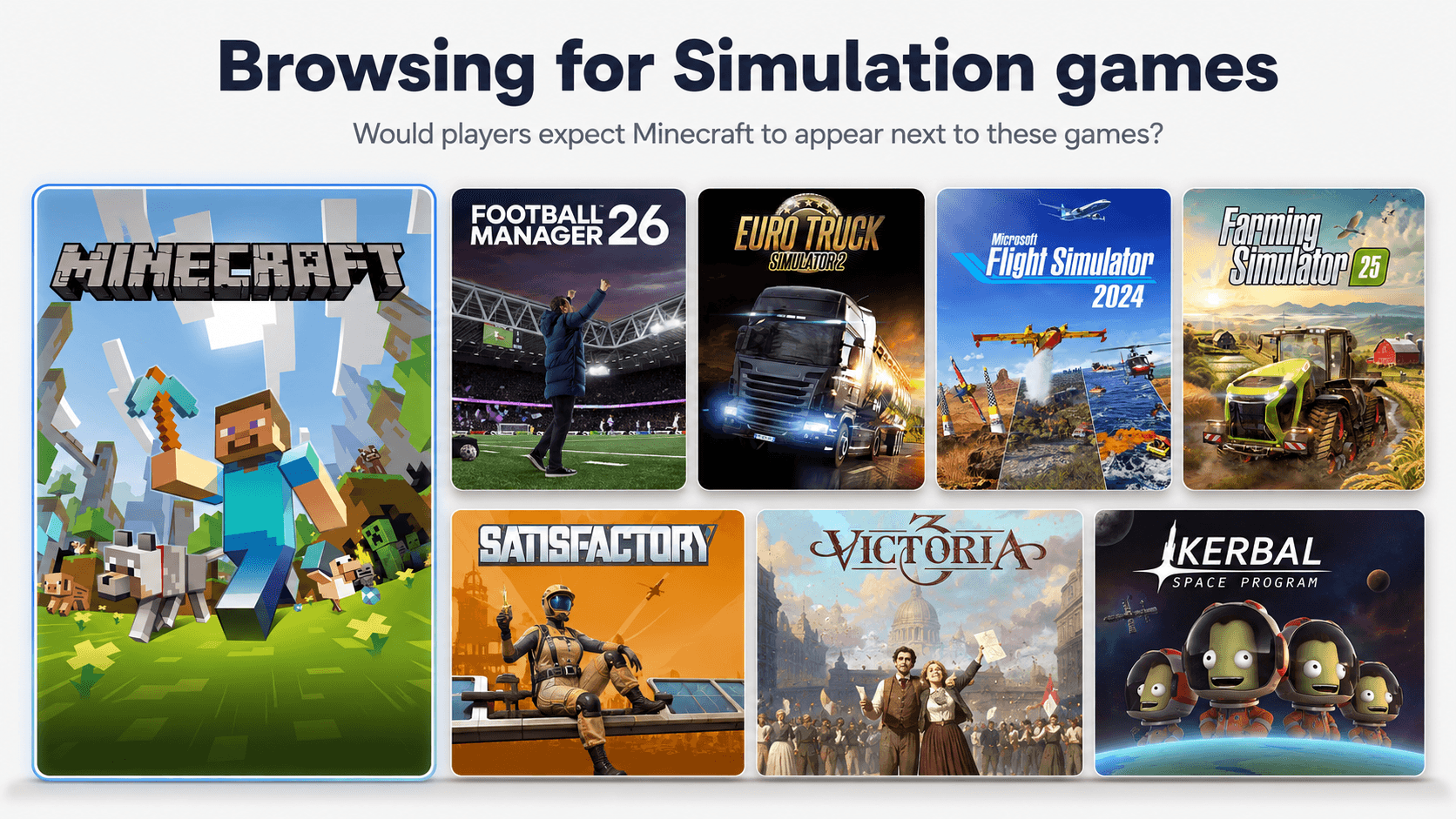
Probably not.
Those games are built around simulating systems, professions, vehicles, economies, logistics, sports management, physics, or real-world activities in depth. Minecraft has systems, but it is not a simulation game in the same sense.
That might seem like a small classification issue. It is not.
At catalog scale, this breaks search and filtering. It makes comparative analysis unreliable. It weakens recommendations. It creates noisy advertising segments. It makes AI workflows harder to trust. And it forces product, data, and content teams to spend time interpreting messy labels instead of using structured data with confidence.
This is why game metadata cannot just be a collection of tags.
Building or fixing your own game taxonomy? Our free implementation guide covers the four core metadata layers and how to structure them. [Get the guide here]
Tags are useful. Structure is what makes them usable.
Metadata is often treated as “data about data.” That is true, but it can also make metadata sound more basic than it really is.
In practice, metadata is what helps systems understand, organize, compare, and retrieve information. It is why search engines can understand web pages. It is why digital cameras store technical information about photos. It is why streaming services can recommend something similar even when they do not have the exact title you searched for.
The same is true for games.
The issue is that game metadata is often reduced to tags. And tags alone are not enough.
Imagine an online store treating a shirt as a flat pile of keywords:
“blue,” “cotton,” “buttons,” “summer,” “brand name,” “slim fit,” “wash cold,” “2024 collection,” “collar,” “long sleeve.”
Some of those words describe the product type. Some describe material. Some describe care instructions. Some describe fit. Some describe seasonality. Some describe visual style. Some are commercially important. Some are secondary.
You would not want all of that mixed together without structure. A product system needs to know which field is color, which field is fabric, which field is fit, which field is care instruction, and which field belongs somewhere else entirely.
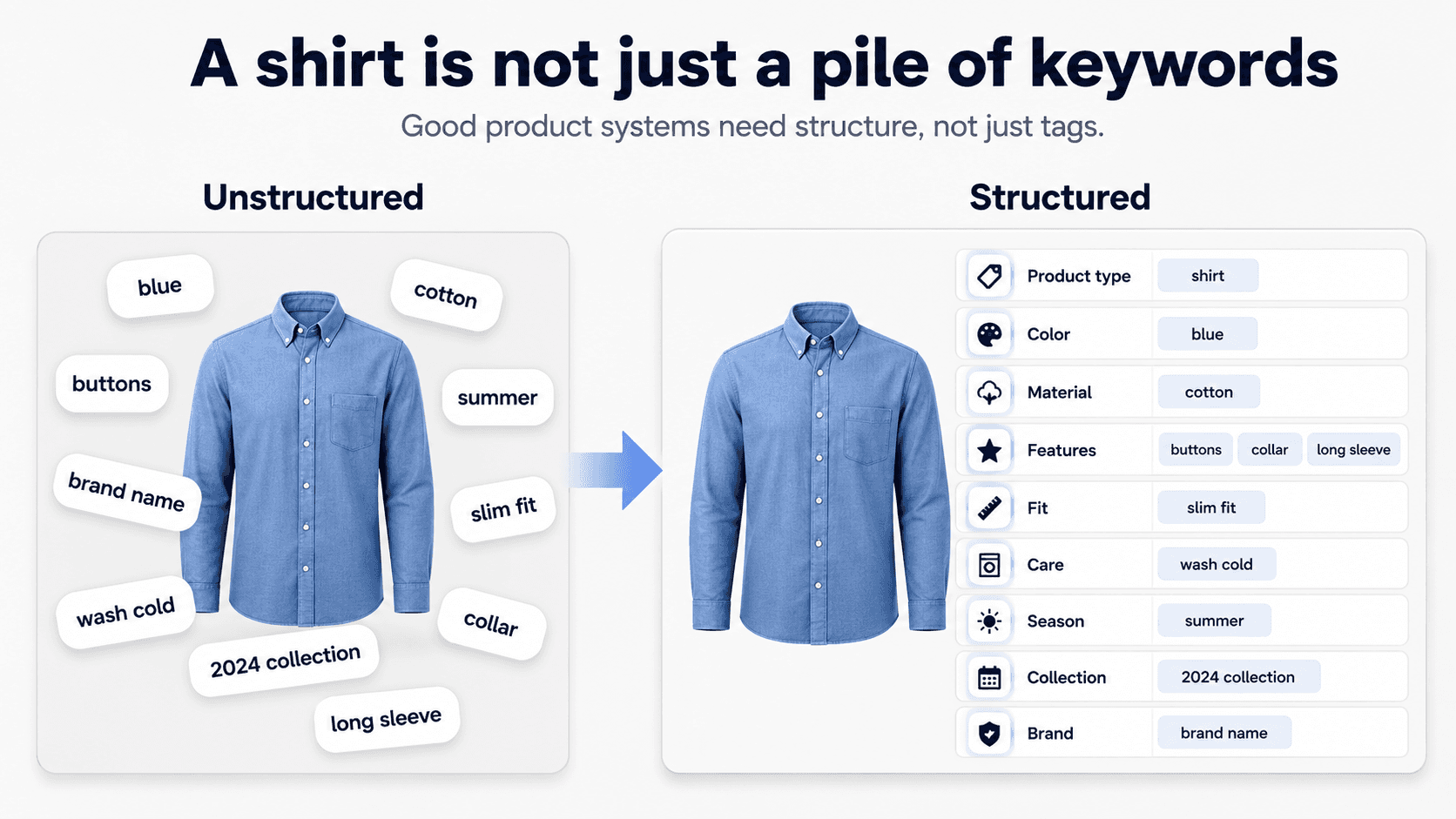
Games are no different.
A flat list of tags can tell you that something exists in or around a game. A taxonomy should tell you what that thing means, where it belongs, how important it is, and how it compares to other games.
That distinction matters.
Flat tags | Structured taxonomy |
Tells you a word is associated with a game | Tells you what that word means in context |
Mixes genres, themes, objects, features, modes, and marketing terms | Separates facts, features, genres, themes, mechanics, story, mood, representation, and more |
Treats all tags as roughly equal | Distinguishes defining traits from secondary traits |
Helps basic keyword matching | Supports search, filtering, recommendations, analytics, AI, and audience intelligence |
Can become noisy at scale | Creates consistent meaning across a catalog |
Often reflects platform, community, or publisher language | Applies shared definitions consistently |
This is the difference Gameopedia focuses on.
We are not trying to build the longest list of games
There are hundreds of thousands of games in the world. Not every game needs the same level of metadata depth.
A small game played by a handful of people does not necessarily need the same level of classification as Minecraft, Fortnite, Roblox, Elden Ring, EA Sports FC, or Clair Obscur: Expedition 33.
That does not mean smaller games do not matter. It means the depth of metadata should be tied to relevance, use case, and value.
Gameopedia has spent 20 years building structured game metadata and taxonomy for the games that matter commercially, culturally, and operationally. Today, we have strong taxonomy coverage across roughly 80,000 to 90,000 games, with depth varying based on the game’s importance and complexity.
Some games may have a smaller set of useful data points. Major games can have hundreds or even thousands of structured data points across facts, media, genres, themes, mechanics, features, modes, story, vibe, representation, accessibility, and more.
That depth is not there to make the database look impressive.
It is there because product systems need structure they can trust.
Search and Recommendations needs it. Catalog and Analytics teams need it. AI systems need it. Advertising and audience intelligence teams need it.
What we mean by the “DNA” of a game
We often describe our work as curating the DNA of games.
That does not mean every game can be reduced to a formula. Games are creative, messy, subjective, and constantly changing. That is part of what makes them interesting.
But beneath the surface, every game has structure.
What does the player do?
How does the player progress?
What are the core mechanics?
What is the setting?
What kind of story is being told?
How is combat handled?
What kind of challenge does the game create?
How does the game feel?
What parts of the experience are defining, and what parts are secondary?
Those questions are not answered well by a single genre label.
Take Clair Obscur: Expedition 33.
At a high level, you could describe it with several genre-like labels: action-adventure, role-playing, strategy, platforming, puzzle. None of those are necessarily wrong if you are only asking whether those elements exist somewhere in the game.
But existence is not the same as importance.
For a player, product system, or analyst, the more useful question is not “does this game contain this element?” The more useful question is “how defining is this element to the experience?”
In our taxonomy, Clair Obscur is better understood as a role-playing adventure game with key action sequences, rather than a game where every present element is treated equally. It has platforming and puzzle elements, but those are not the main reason the game exists. It has strategy, but not in the same way as a dedicated strategy game. It has real-time actions inside combat, but that does not make it a pure action game.
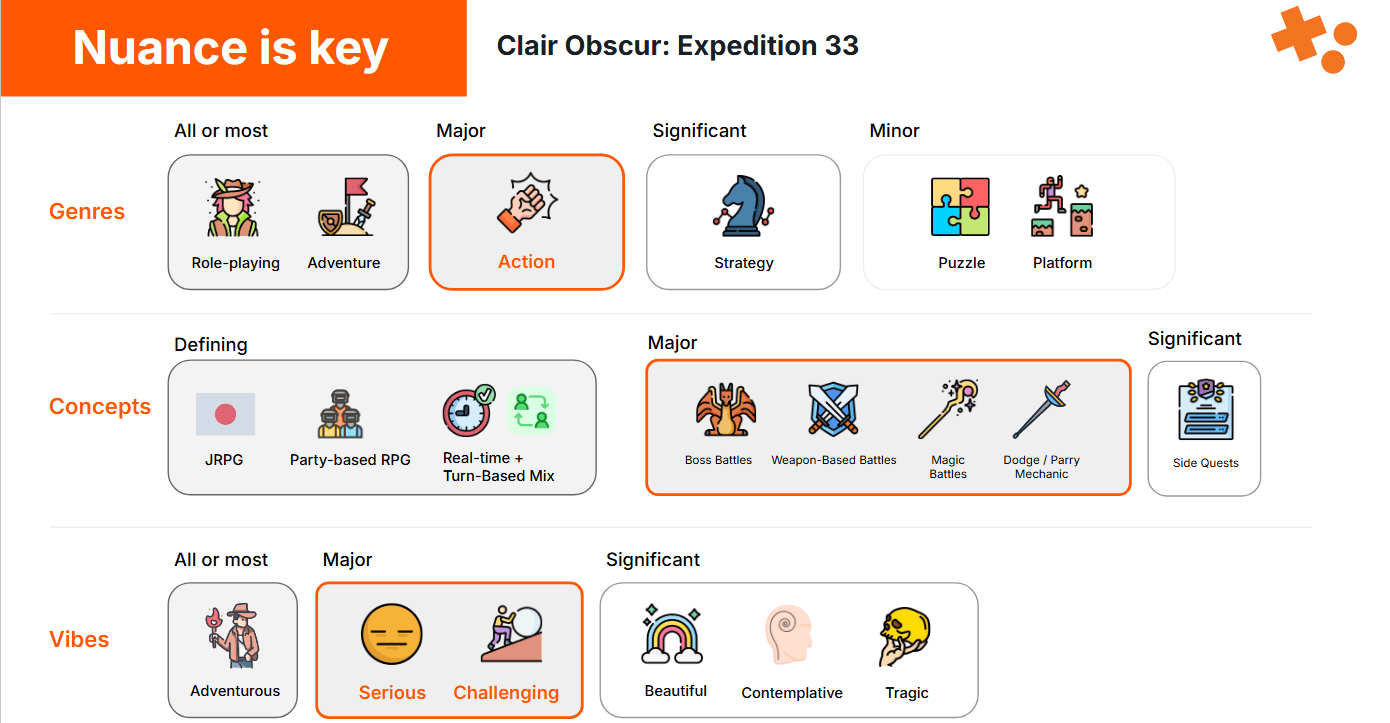
Then you can go deeper.
Does the game use action points?
Are there boss battles?
Is combat magic-based, weapon-based, or both?
Is the fantasy high fantasy or low fantasy?
Are there quick-time events?
Are there side quests?
How does character progression work?
How are skill points earned?
Is the game party-based?
Is movement real-time?
Is combat turn-based, real-time, or a mix?
Is the world open, semi-open, or built from closed environments?
How is the story delivered?
What is the game’s vibe?
Who do you play as?
Which details should be marked as spoilers?
This is where taxonomy becomes more than labeling.
It becomes a way to understand the game as a system.
Curation starts before release and continues after launch
A game is not static.
It can be announced years before launch. It can change during development. It can receive trailers, demos, platform updates, release date changes, new screenshots, new publishers, new modes, new monetization models, DLC, expansions, live-service seasons, balance updates, and major content changes after launch.
So our work does not start and stop with release.
Our teams track the games industry every day. We follow announcements, showcases, platform updates, publisher news, official trailers, gameplay footage, patch notes, release changes, and customer or partner signals. Events like PlayStation State of Play, Summer Game Fest, The Game Awards, and other publisher showcases can create large waves of new and updated information.
That information is then reviewed, assigned, and curated by trained specialists.
We broadly separate the work into two areas: facts and media, and taxonomy.
Facts and media cover the more objective parts of a game:
title
alternative and localized titles
developer
publisher
co-developers and porting studios
platform availability
release dates
age ratings
descriptions
screenshots
trailers
cover art
technical details
system requirements
controller support
store and platform identifiers
Taxonomy covers the classification and interpretation of the game:
genres
subgenres
themes
gameplay features
mechanics
modes
progression systems
combat systems
story structure
setting
graphical style
perspective
mood and vibe
accessibility features
representation
spoiler-sensitive story concepts
Facts are often about verifying what is true.
Taxonomy is about applying definitions consistently.
Both matter. But they require different skills.
Human expertise is still central
Gameopedia does not use crowdsourcing for this work.
Our gaming specialists go through months of training before they classify games independently. They learn the definitions, the edge cases, the relationships between data points, and the reasoning needed to classify games consistently.

This is important because games rarely fit neatly into one box.
If a game is an RPG, you often expect some kind of progression system. But what kind? Character levels? Skill trees? Equipment progression? Party management? Action points? Branching decisions? Turn-based combat? Real-time combat? A mix?
These things are connected. A good curator is not looking at one field in isolation. They are building a structured understanding of the whole game.
That also means there will be edge cases. Internally, we discuss and challenge definitions. We ask whether a concept is too broad, too narrow, overlapping with another concept, or being applied inconsistently. Sometimes a definition needs to be refined. Sometimes the answer is already in the framework, and the challenge is applying it correctly.
This is part of the work customers often do not see.
The hard part is not only collecting information. The hard part is defining what the information means, applying it consistently, and keeping it useful over time.
AI helps, but it does not remove the need for structure
AI is already changing metadata workflows. We see that clearly, and we are working with AI ourselves.
But AI does not remove the need for taxonomy. It makes the need for taxonomy more obvious.
If you ask a general AI model to classify a game, you may get a reasonable-looking answer. The problem is that you may not get the same answer twice. You may also get an answer based on noisy public sources, platform tags, marketing copy, community language, or other databases with their own definitions.
That might be fine for a lightweight use case.
It is not fine if you need comparative data across a catalog; if your recommendation system depends on consistent similarity; if your analytics team is trying to understand a genre; if your advertising team is building gaming audience segments; or if your platform needs to explain why one game is related to another.
AI can help with scale. It can support research, extraction, summarization, candidate classification, and workflow efficiency.
But AI needs structure, definitions, framework, and QA.
Otherwise, it does not solve the metadata problem. It just produces more metadata faster, and potentially scales inconsistency faster.
Why this matters for platforms, catalogs, and discovery
The value of structured taxonomy becomes especially clear when you look at platforms that aggregate games or gaming content from many sources.
A gaming aggregation platform might include games from Xbox Cloud Gaming, GeForce NOW, Boosteroid, Blacknut, PlayWorks, and other providers. A community or content platform may need to understand games across videos, creators, communities, and user behavior. A retailer may need to improve search, product pages, recommendations, and long-tail discovery. An advertising partner may need to define gaming audiences with more nuance than “people who play games.”
In each of these cases, the same problem appears.
Different sources describe games differently.
Different platforms use different definitions.
Different providers have different levels of metadata quality.
Some games are deeply described. Others are barely described at all.
And the customer still needs one coherent experience.
This is where Gameopedia is often used as a trusted source of structured game understanding.
Our data supports companies including Google, YouTube, Discord, Samsung, LG, and Amazon, helping power use cases across discovery, catalog understanding, personalization, advertising, and analysis.
The common thread is not just “more metadata.”
The common thread is trusted structure.
The goal is not more metadata. The goal is more useful metadata.
It is easy to assume that the answer to every metadata problem is more data.
More tags. More sources. More automation. More coverage.
Sometimes that is true. But often, the real issue is not volume. It is meaning.
Can your system tell the difference between a defining genre and a secondary element?
Can it separate official facts from subjective interpretation?
Can it understand why two games are similar?
Can it compare games consistently across a catalog?
Can it support AI without feeding it noise?
Can it keep up as games change?
That is the work we care about.
At Gameopedia, our approach is to define how games should be understood, curate that understanding with trained experts, use technology and AI where it helps us scale, and protect quality through structure and QA.
Games are complex. Good metadata should not flatten that complexity into a pile of tags.
It should make that complexity usable.
If you are working on game discovery, catalog quality, recommendations, audience intelligence, or AI-powered game understanding, we are always happy to talk.