


Custom Game Taxonomy: the competitive advantage most platforms still ignore
Delphine Fumar
Content Manager
@Gameopedia
Read Time :
5 minutes
Custom Game Taxonomy: the competitive advantage most platforms still ignore
Every time your platform signs a new content provider, you inherit their opinion of what a game is, and genre is only the most visible part of it. One provider calls a game an action RPG, another says it's a co-op, and another tags it as "dark" with no sense of how dark compares to the next game in your catalog.
That's not a data-entry problem you can staff your way out of. You can normalize and ingest a provider's feed into your own genre list, and it will work for every title your team classifies directly. But it won't settle what "dark," "fast-paced," or "action RPG" mean to a partner, or catch it when they redefine one six months from now.
A generic taxonomy survives inside one catalog. It doesn't survive contact with a second one, and every platform pulling from more than one source is running on some version of the same unresolved disagreement, on mechanics and mood as much as genre.
That's the gap a custom game taxonomy exists to close.
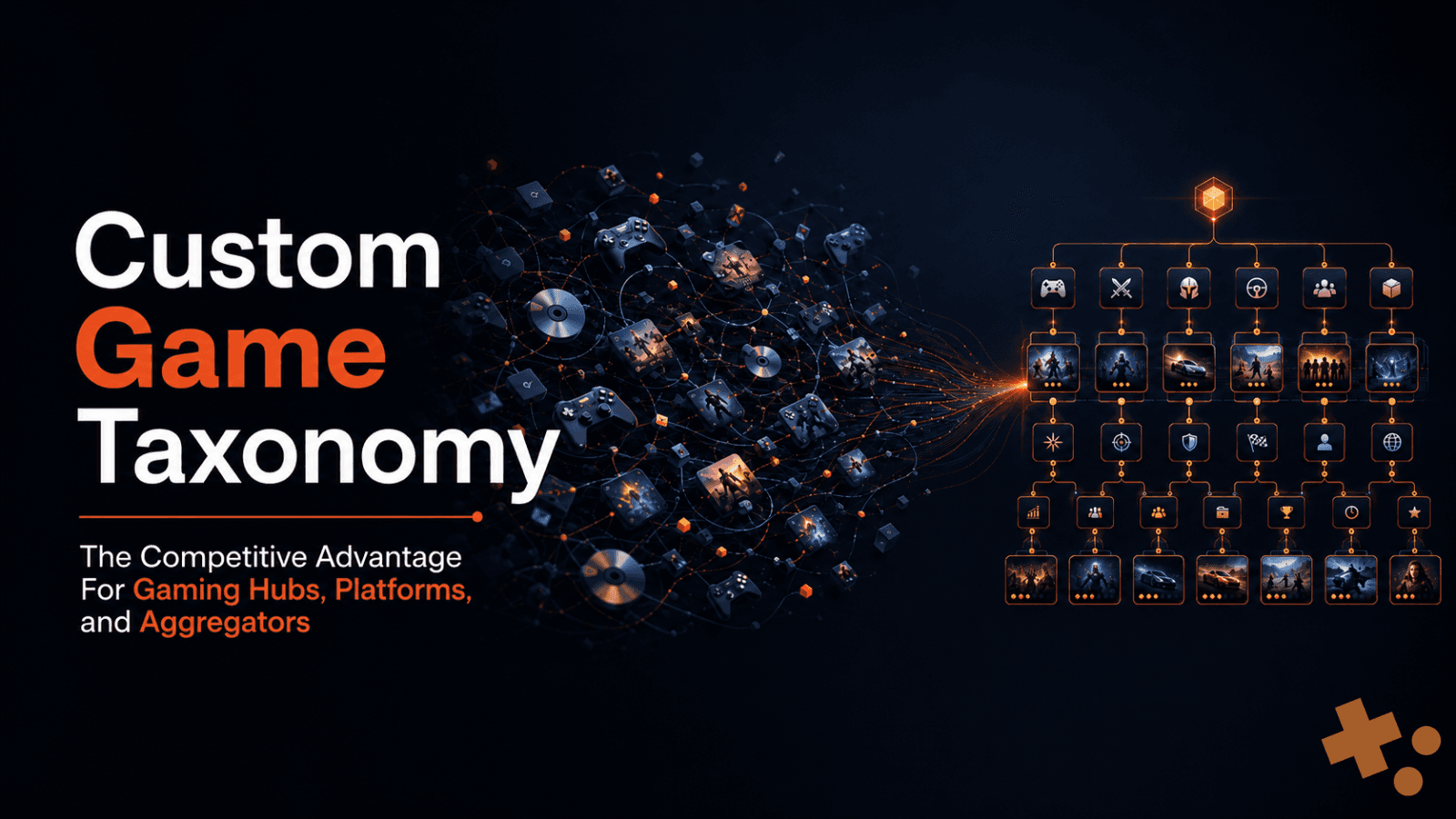
A custom game taxonomy is a platform-specific classification system that breaks a game down past genre into mechanics, themes, art style, pacing, and mood, quantifying how much of each attribute applies instead of treating classification as yes or no. A game can be roughly 80% action and 20% puzzle, which is the difference between a recommendation engine surfacing it to a puzzle fan and burying it because the genre tag alone reads as pure action.
That granularity is the competitive advantage most platforms are missing, because most catalogs are still running on genre tags patched provider by provider instead of a taxonomy built to hold it.
Every provider you add, every title you license, is an investment in your catalog. That investment only pays off in retention if players actually find the games that fit them, and generic tags can't carry the nuance that makes a recommendation land. That's what the rest of this covers: the cost of leaving this to chance, and how to close it properly.
Game discovery is more than a UX problem
In the past few years, platforms and storefronts have been competing on other fronts than content availability, pricing, or technical performance. The main battlefield now is their game discovery strategy.
Two platforms can license the exact same catalog and still perform completely differently. Because the one that actually helps a player find the right game at the right moment is the one winning the competition. That capability runs on nothing more mysterious than how well the underlying catalog is classified.
Search and recommendations
When tags are shallow, search and recommendations start guessing. A player filtering for a specific mood or mechanic gets matches based on whatever blunt category happens to overlap, which is exactly why search can fail even when the game a player wants is already sitting in the catalog.
The costs compound:
Lower engagement, because fewer sessions end in a match that actually lands
Weaker monetization of long-tail titles, since they only ever surface by luck
Heavier reliance on paid promotion to do the job discovery should be doing for free
Player behavior that flattens toward whatever's already popular, because that's the safest bet a shallow system can make
Discovery quality shows up directly in platform economics, not just in how the product feels to use.
Curation and merchandising also suffer from weak data infrastructure
Search isn't the only system running on the same shallow tags. Every curated collection, seasonal campaign, and "new and trending" shelf leans on the same blunt signals, genre, popularity, franchise, release date, because those are the only ones with enough coverage to build on.
Putting together a "cozy games for the holidays" collection without mood or pacing data means checking hundreds of titles by hand, or skipping the theme and running another "best-selling RPGs" shelf instead. Franchise and novelty become the default merchandising logic because neither requires any classification work, and the same well-known titles get featured on repeat while games that would have fit a themed moment perfectly stay buried.
A platform spends budget on a seasonal campaign, and the campaign ends up promoting the titles it always promotes, the exact pattern that's already broken discovery at online storefronts, while the long-tail catalog it paid to license sits untouched, again.
Why generic game taxonomy creates commoditized discovery
Genre is the one field every provider fills in, even when they don't agree on the answer. That inconsistency doesn't stop it from being the closest thing the industry has to a shared starting point. This is also why every platform's search and recommendations end up running on roughly the same limited inputs, describing games using the same handful of genres, no matter how different the actual catalogs are.
That's the part licensing budgets don't protect against. A platform can spend years securing exclusive titles and building out a distinctive back catalog, only to end up with a browse page that looks and behaves like a competitor's, because the classification layer underneath flattens everything to the same handful of labels.
A few places this shows up directly:
"You might also like" shelves built on genre alone tend to converge on the same obvious matches across every platform, regardless of what's actually in the catalog.
Search results for broad terms like "RPG" or "shooter" start looking interchangeable between platforms, since the tag set behind them is the one thing every provider reliably has, even if the values behind it don't match.
Catalog positioning turns reactive, chasing what's trending industry-wide instead of surfacing what's genuinely distinctive in a platform's own catalog, because distinctiveness was never captured in the data to begin with.
What's actually at stake is whether a player has any reason to notice the difference between platforms at all, beyond price or which storefront happens to hold a given license. A taxonomy built with design and discovery in mind gives a catalog its own vocabulary, one competitors running on generic tags aren't using too, and that's what actually turns a different catalog into a different experience.
What a custom taxonomy actually enables
Custom game taxonomy is often misunderstood as better tagging. In reality, it enables platforms to define how games are understood at a structural level by breaking them down into more granular attributes and classifying them under specific tags rather than broad labels alone. Once a taxonomy starts capturing mechanics, mood, art style, skill levels, or pacing, four things become possible that a genre-only system can't do, each one a point where a platform running on real structure pulls ahead of one that isn't.
Semantic discovery that matches intent, not just category
A player typing "chill games" or "something relaxing" into search is describing mood and pacing, thinking to themselves that they'd like something to unwind after a long day. Matching that intent needs search built on more than genre tags, because a keyword-matching system can't understand this vocabulary no matter how good the ranking algorithm is.
It's also what lets a platform tell two adventure games apart even when they share a genre tag. One leans historical, the other mystery, and a player who wants one shouldn't get matched to the other.
This isn't unique to our industry. Netflix hit the same wall on the content side: in the early 2010s, the company built out tens of thousands of micro-genre combinations, because a handful of broad categories couldn't represent how people actually browse. The same logic applies to a game catalog.
Personalization that reflects actual play patterns
On your storefront, taxonomy doesn't personalize anything by itself. That's the recommendation engine's job. What the taxonomy sets is the ceiling on what that engine can ever detect, whether that's a hand-curated collection or an AI search companion.
Built on genre alone, a recommendation engine treats a player's history as a genre preference: more RPGs, because the last five purchases were tagged RPG. Feed it mechanics, pacing, and mood as separate fields instead, and the pattern underneath the genre becomes visible, a player who actually favors high-difficulty, high-narrative, multiplayer titles, regardless of genre. Now it can recommend across genre lines instead of within them, and capture spend a genre-only competitor's engine structurally can't see in the first place.
It's also what lets a recommendation engine say anything useful about a brand-new title with almost no purchase history. Genre alone can only compare it to other titles sharing the same broad tag.
Merchandising that surfaces real catalog gaps
A game taxonomy that spans mechanics and themes turns merchandising into catalog analysis instead of guesswork. Your team could then be able to spot:\
Which subgenres or themes are thin or overrepresented.\
What kind of new editorial collections could be created.\
Where a licensing gap is actually costing engagement instead of just feeling like one.
A platform that can see a thin subgenre in its own catalog can act on it, license into it, promote around it. A competitor still going by the broad tags of genre, novelty or franchise can't even name what's missing.
Long-tail monetization that depends less on luck
Niche titles depend a lot less on luck once discovery can match on mechanics and mood instead of just genre and popularity. It's essentially Chris Anderson's Long Tail argument, applied to a game catalog. Niche demand turns into revenue once discovery can connect players to niche titles on its own, without shelf space or ad spend doing the work.
A quiet, narrative-heavy strategy game can surface through pacing and tone alone, matching a player's history with a fraction of the reviews or marketing budget behind a bestseller. It doesn't eliminate the need for marketing. A new title with no interaction data yet still needs an initial push. But it cuts how much of a catalog's long-tail performance rides on marketing spend alone.
What it takes to build a custom game taxonomy that lasts
Every AI-powered recommendation model and search tool is getting easier to buy or build. That's not where the advantage lives anymore. Your competitive advantage in the game industry is the quality of the structured data feeding those systems.
Platforms that put off building real structure accumulate discovery debt instead: patchwork tagging that gets harder and more expensive to untangle as the catalog grows, because every new provider added on top makes the reconciliation problem worse.
What a comprehensive taxonomy has to get right
The rules need game expertise behind them.
Whether a title reads as tense or dark, co-op or merely multiplayer, is a judgment call made thousands of times over. Make those calls inconsistently and your ops team scales the inconsistency. Players feel it as recommendations that seem random, and product metrics slide with no obvious cause.
Depth has to land where your traffic is.
The games carrying your search volume and storefront placements need deep coverage of gameplay mechanics, mood, pacing, and art style. The long tail needs enough to be found at all. That balance decides which games players can reach, and which licensing spend ever turns into play sessions.
It has to be maintained for the life of your catalog.
Providers redefine their tags, live-service games add modes years after launch, and new subgenres like extraction shooters appear mid-cycle. A taxonomy frozen at launch drifts back into the fragmentation it was built to fix. Every new integration then reopens a backlog your team thought was closed.
None of these has a finish line. That's the work Gameopedia Metadata takes off your team: gaming nuance turned into structured data, maintained as a product, so every provider you add speaks a common language for games.
Every game in your catalog is already paid for. A custom game taxonomy is how your players find it. Talk to us about your catalog