


As the World Goes All-In on AI, Gaming Has a Unique Advantage
AI isn’t just changing games. It’s changing gaming platforms. Explore why the real competitive edge lies in the intelligence layer underneath.
Aleksander Kjeserud
Director of Strategic Research and Business Development
@Gameopedia

AI isn’t just changing games. It’s changing gaming platforms. The real competitive edge lies in the intelligence layer underneath.
When a company the size of Microsoft appoints someone from its AI division to lead Xbox, that isn’t routine succession planning, it's a massive structural pivot.
Leadership changes at that level rarely signal continuity. They signal a phase transition. And this one suggests something important: gaming is no longer just a content category to compete in. It is becoming part of a broader AI platform strategy.
If that’s true, the AI opportunity in gaming is far more foundational than generative AI assets or AI-driven NPCs.
It’s embedding AI at an infrastructural level in modern video games.
Game AI Isn’t New. But It Is Moving Up the Stack.
AI gaming has existed for decades. From rule-based enemy behavior to finite state machines and procedural systems, artificial intelligence has long lived inside the game engine. The first examples of AI in gaming date back to the 1940s, with early video games like Nim and checkers programs developed in the 1950s. These first examples relied on stored patterns, movement algorithms, and heuristic rules to simulate intelligent behavior, laying the groundwork for more advanced AI in later video games.
But that layer of AI in video game development was local. It shaped how enemies moved, how difficulty scaled, how game worlds were generated. Procedural generation and procedural content generation (PCG) are AI techniques used to autonomously create in-game content such as levels, non player character dialogue, and sounds, with minimal inputs from game designers or game developers.
What’s happening now sits above the game.
We are moving from game-level AI to platform-level AI.
The shift is subtle but significant.
Historically, Xbox competed as a gaming-first organization: consoles, exclusives, subscriptions. Win inside the gaming category.
But if Microsoft is truly all-in on AI, gaming becomes something else entirely.
It becomes:
A behavioral dataset
A training and evaluation environment
A discovery engine
A personalization layer
A live experimentation surface
Gaming is one of the most data-rich, engagement-heavy consumer ecosystems on the planet. Every session, every preference, every churn event, every update reaction generates signal that can be transformed into actionable insights with AI-powered game intelligence platforms.
That gives gaming a unique advantage in an AI-first world.
But that advantage only materializes if the signal is structured.
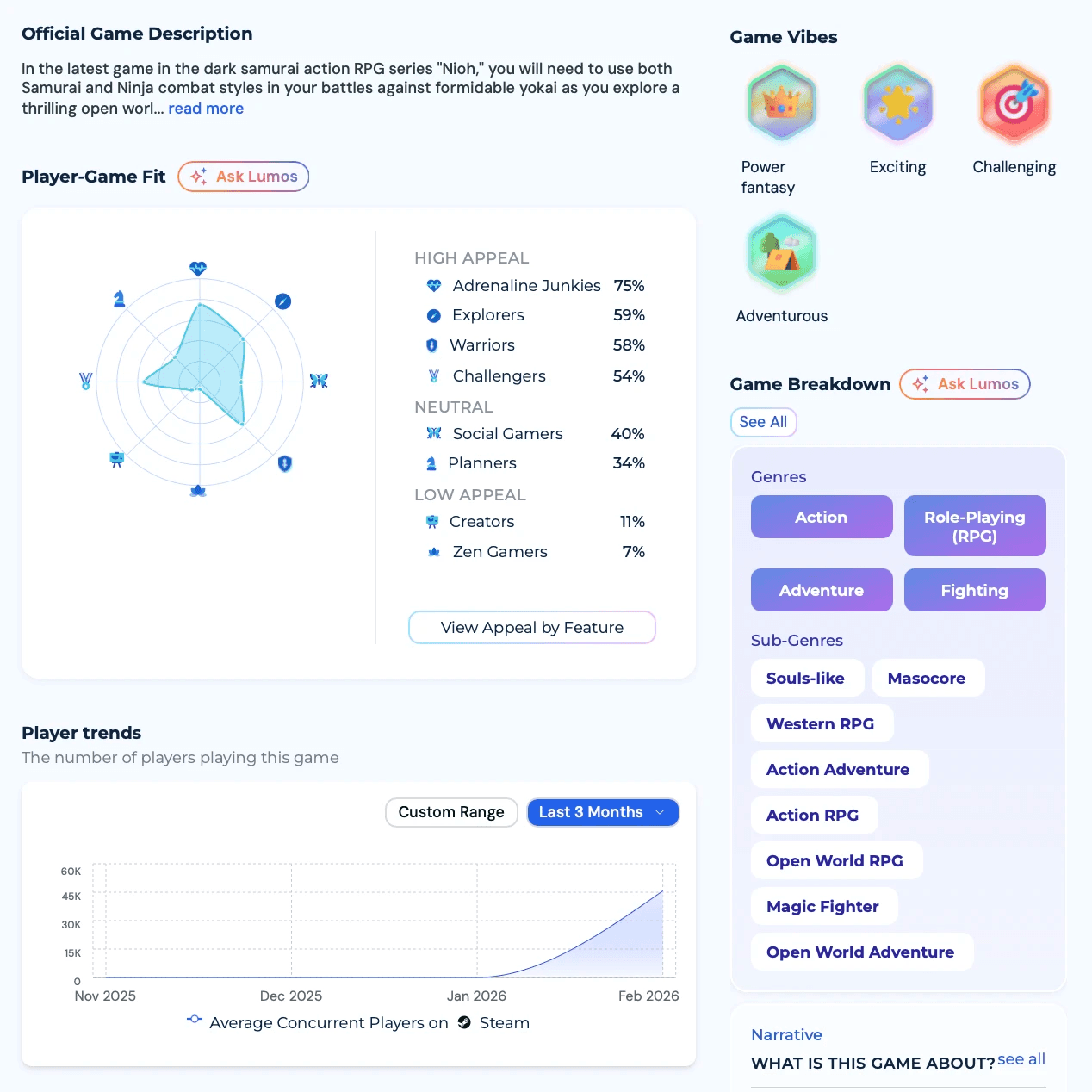
The Real Constraint Isn’t Compute. It’s Grounding.
The industry is currently obsessed with model size.
Bigger models. More GPUs. Faster inference.
But the constraint in AI gaming is not compute. It is grounding.
Foundation models can summarize patch notes. They can cluster reviews. They can generate marketing copy.
What they cannot do reliably is reason over gaming context without domain grounding.
A generic model does not inherently understand:
Why “the grind” is a feature in an ARPG but a flaw in a narrative adventure
The mechanical distinction between a roguelike and a roguelite
How meta-progression affects long-term sentiment differently from character progression
What constitutes a high skill ceiling versus poor onboarding
Game AI is distinct from academic AI, focusing on delivering engaging and believable behavior rather than achieving true intelligence. In game design and development, advanced AI techniques, such as neural networks, behavior trees, and planning algorithms, are used to create more realistic, adaptive, and interactive experiences for players, enabling believable non-player character behavior in modern games.
Without structured domain knowledge, AI-driven discovery becomes a random recommendation engine wearing a tuxedo, limiting the effectiveness of AI-driven market intelligence for game marketers and strategists.
If gaming platforms evolve into AI-powered ecosystems, they will need robust game analytics that combine player data with structured metadata:
Deep, structured metadata about games and player behavior
Gaming-native taxonomies and ontologies
Labeled datasets for training and evaluation
Intelligence layers that support AI-driven discovery and personalization
This is not solved by plugging a large language model into a storefront.
It is solved by building structured gaming intelligence.
From Genre Buckets to Semantic Intent
Today’s storefronts still rely on broad genre categories and engagement signals.
Action. RPG. Strategy. Top Sellers.
But players don’t think in genres. They think in intent.
A player isn’t looking for “an RPG.” They’re looking for a tactical experience with meaningful loot progression.
Or they’re looking for a relaxing city builder with a realistic graphic environment. Or a competitive 1v1 fighter with a high skill ceiling.
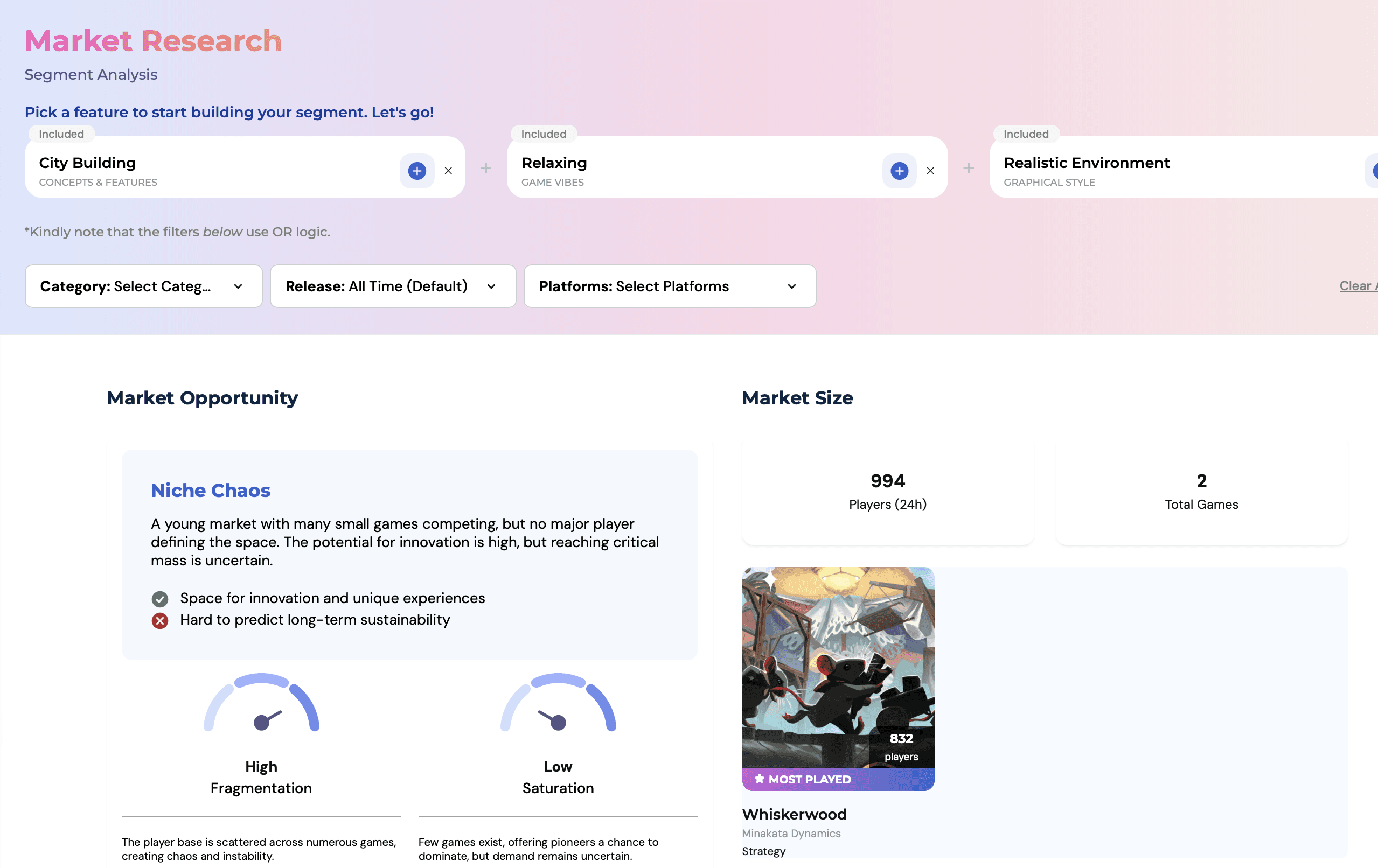
To support that level of intent, platforms need more than engagement metrics; they need structured, gaming-native metadata to power precise game discovery, backed by comparison engines that benchmark games, features, and market segments side by side.
They need an intelligence layer capable of structuring a comprehensive and flexible video game taxonomy:
Granular mechanics informed by a detailed genre taxonomy for game design and discovery
Pacing and progression systems
Skill ceilings and feedback loops
Psychographic player motivations surfaced through video game sentiment analysis across reviews and communities
Sentiment shifts over time
AI can create bespoke gaming experiences by analyzing real-time data to dynamically adjust the game environment, enhancing gameplay and delivering more personalized, immersive gaming experiences across devices and platforms, especially when informed by deep analysis of game mechanics, features, and engagement drivers.
Without that structure, AI-driven personalization is guesswork, as the shift to digital storefronts has shown in the absence of rich metadata powering modern game discovery.
With it, discovery becomes precise.
The Interoperability Problem
There’s another structural constraint.
Gaming data is fragmented.
Valve, Sony, Microsoft, Epic; each platform owns part of the ecosystem. None owns the whole picture.
For an AI platform strategy to succeed at scale, data cannot remain siloed.
The next competitive moat may not be exclusive titles or hardware advantages.
It may be the ability to create a universal schema: a structured, interoperable layer that allows AI systems to reason across engines, storefronts, and player contexts.
Whoever defines that schema shapes the intelligence layer.
And whoever shapes the intelligence layer shapes the platform.
The Human Moat
There is also a cultural constraint.
Gamers are deeply protective of authenticity. If AI systems are perceived as optimizing the fun out of games or replacing creativity with algorithmic filler, backlash will follow.
That’s what makes gaming a powerful AI testbed.
If discovery engines manipulate players, they leave. If personalization feels hollow, they churn.
Gaming offers real-time feedback on whether AI feels useful or extractive, especially when studios leverage gameplay and engagement data to make better games and follow expert insights on data-driven game development and market trends.
That feedback loop is not a weakness.
It’s a moat.
It forces AI systems to be grounded not only in data, but in player trust.
From Metadata Vendor to AI Infrastructure
All of this points to a strategic shift.
Structured domain intelligence is no longer back-office enrichment.
It is performance infrastructure.
In an AI-first gaming ecosystem, structured data:
Grounds models
Reduces hallucinations
Improves personalization
Strengthens discovery relevance
Increases retention
The winner in AI gaming will not be the company that trains the largest model.
It will be the company that understands the domain deeply enough to structure it.
The intelligence layer is becoming the primary asset.
In 2026, almost every game studio is actively deploying AI in their production pipelines, leveraging AI to revolutionise asset creation, level design, and QA processes, and using advanced tools and resources from leading developers to support structured domain intelligence.
And structured gaming knowledge, ontology, taxonomy, normalized video game metadata across platforms, is what makes that layer possible.
The Macro Shift
When AI-native leadership enters gaming strategy, it signals something bigger than incremental product evolution.
It suggests that gaming is becoming part of AI platform architecture, underpinned by comprehensive video game metadata and product data infrastructure.
Not just content to distribute.
Not just experiences to monetize.
But a proving ground for how AI systems discover, personalize, evaluate, and adapt at scale.
Artificial intelligence is transforming the gaming industry by enabling smarter, adaptive, and more immersive experiences. The collective imagination of developers, players, and industry leaders will shape the future of AI gaming, driving innovation and redefining what is possible.
The future of AI gaming will not be defined by smarter NPCs or more impressive generative tools, but also by rigorous video game genre taxonomies based on core mechanics.
It will be defined by who owns and structures the intelligence layer underneath.
In the AI era, raw data is noise. Structure is signal.
He who controls the schema, controls the platform.
Explore Gameopedia Metadata
Aleksander Kjeserud
Director of Strategic Research and Business Development
@Gameopedia