


Exploring richer game discovery through the Nintendo Store
Delphine Fumar
Content Manager
@Gameopedia
Read Time :
8 minutes

Spotify has a Mood category. Netflix shelves Feel-Good Comedies beside Understated Dramas. Across music and film, describing how you want to feel has become a normal way to find something.
Game catalogs are still mostly organised around what a game is rather than what it’s like to play. Type a mood instead of a genre into a storefront’s search bar and what comes back may have little to do with the experience the player was after. Qualities like subgenre, vibe and how a game actually plays tend to get written up differently by every source that touches them. Structured metadata is what pulls those descriptions back together, so a catalogue can be searched on what its games are like to play, not only on what they're called.
Even established digital storefronts have opportunities to make game discovery more intuitive. As game catalogues grow, structured attributes describing gameplay, mood and player experience can complement existing search, browsing and recommendation features.
Using examples from Nintendo's publicly available storefront, this article explores five ways richer structured game metadata could support new discovery experiences, building on the search, filtering and browsing capabilities already available.
1. Search based on player intent
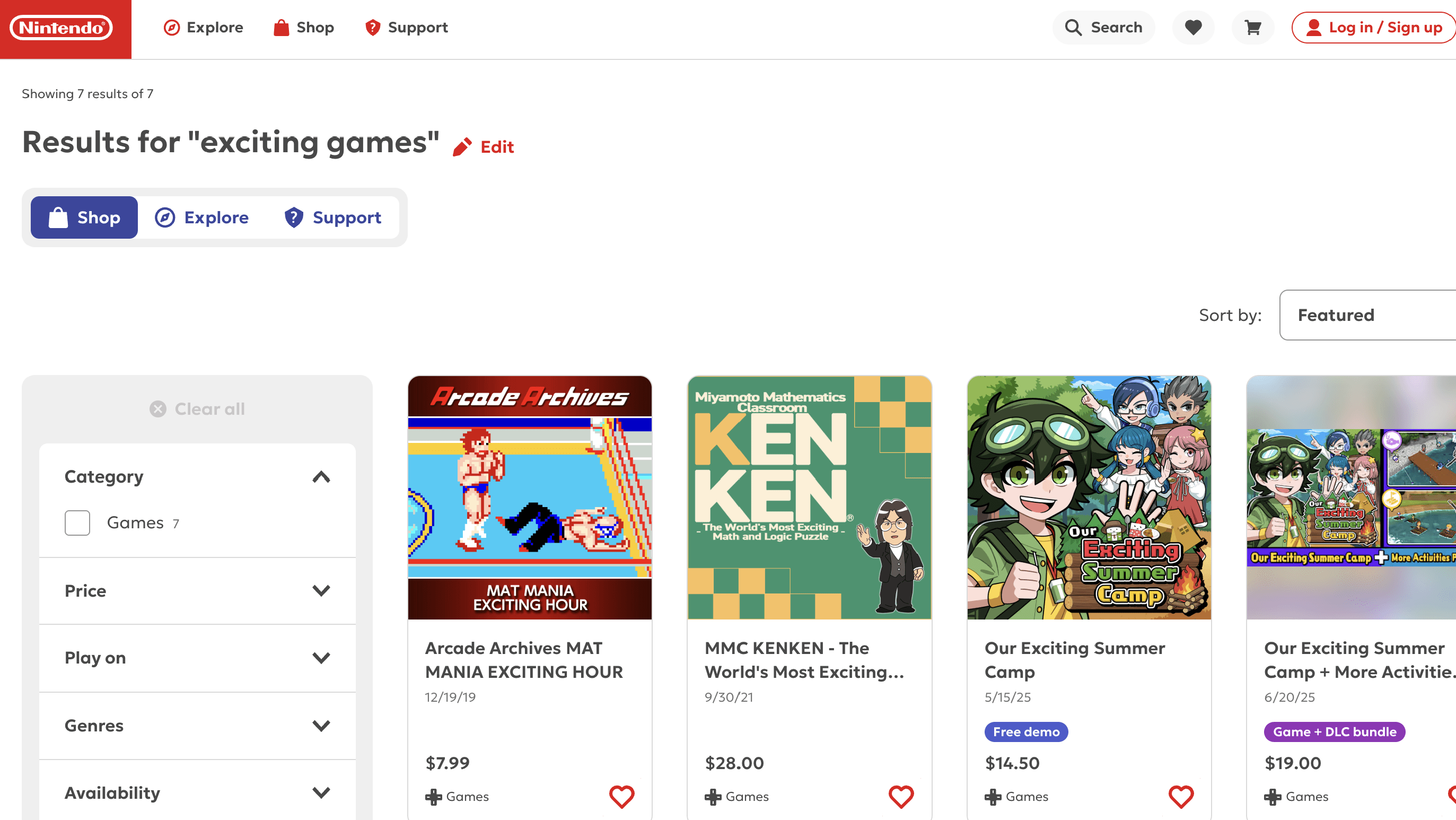
Search "exciting games" on the Nintendo Store today and you get seven results. Among them: a 1986 arcade boxing game, a math logic puzzle book, and a summer camp life-sim. Each of those titles does contain the word "exciting" somewhere in its name, so the results line up with the query exactly as it was typed.
That outcome isn't specific to one storefront. It's what any text query returns when a player types a feeling rather than a title. "Exciting" describes how a game plays, and the games that genuinely deliver that feeling rarely announce it in their names. The word a player reaches for and the words printed on a product page are doing two different jobs.
Most storefronts, Nintendo's included, already offer two strong routes into a catalog: curated shelves, which are editorially sharp but necessarily finite, and the full catalog, which is comprehensive but large to sort. There's room for a third route between them, where a player describes roughly the experience they want and gets a useful set back.

Giving mood a place to live
That third route runs on a taxonomy built around how games feel to play. Attributes for pace, intensity and tone, reconciled across however many ways different sources describe the same quality, whether that's "adrenaline-fueled", "high-energy" or "intense".
Sitting alongside existing search, that layer lets a query like "exciting games" also reach titles that are actually paced that way, not only the ones carrying the word. The player gets both: the literal matches they asked for, and the games they probably meant.
The same attributes open up the middle-ground browsing players keep asking for. Campaign length is a good example. Gameopedia bands story length from 1-3 hours up through 100+, which turns "something we can finish this weekend" into a filter rather than a forum thread. The same applies to cozy and relaxing games, family games, or games similar to one a player already loved. Most of these already exist as structured attributes. They just haven't been handed to a storefront yet.
2. Filter games by featured characters
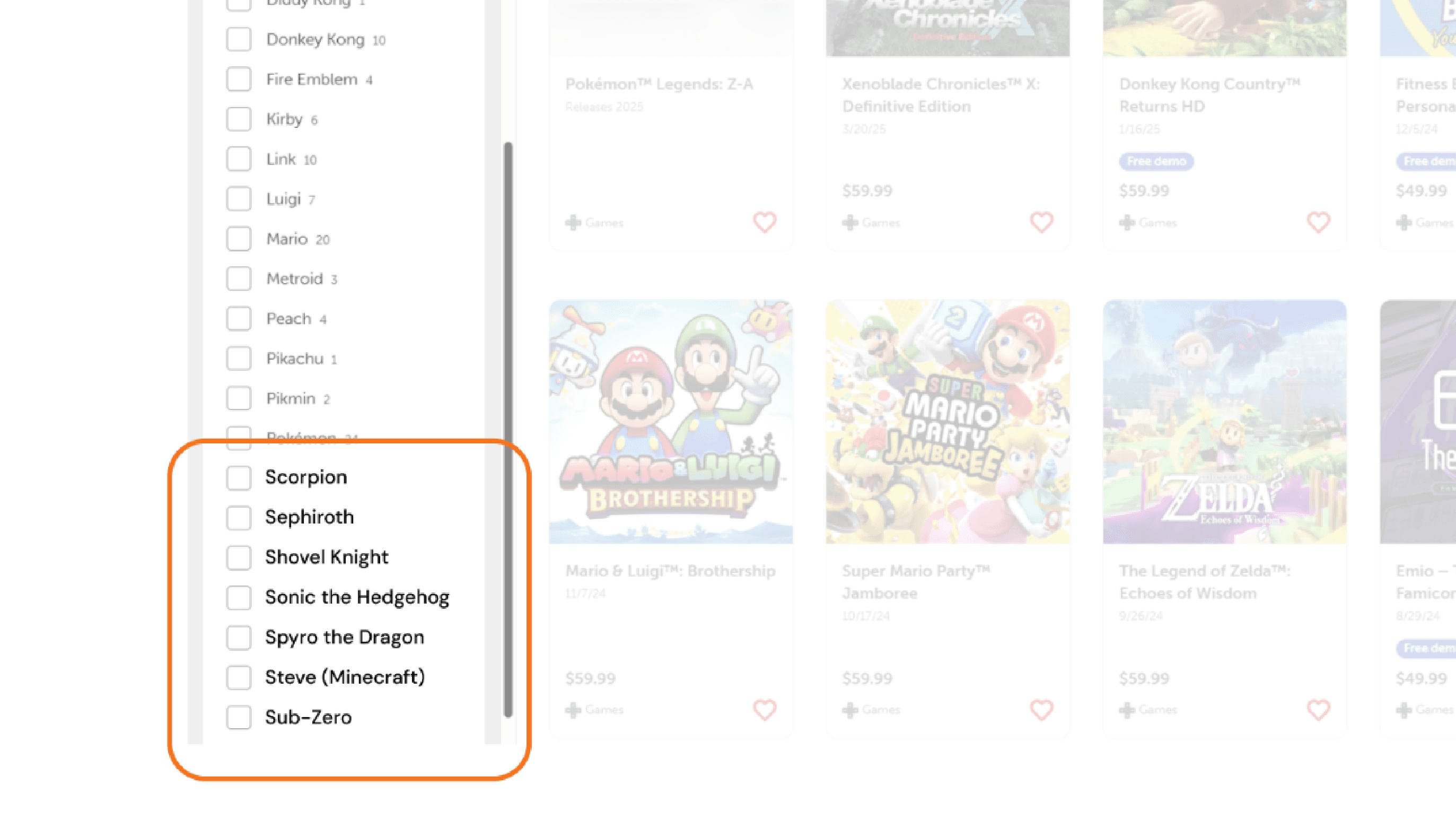
Nintendo's Characters and series filter is a genuine differentiator. Most storefronts don't offer character as a browsing dimension at all, and for a player who arrives through a character rather than a genre, it's the most natural way into a catalog there is. It's also one of the clearest signals that the store understands how people actually talk about games.
It's a dimension with real headroom, too. Character coverage is difficult to maintain at catalog scale anywhere, because character isn't a required field the way genre or price is. Standard submission processes don't ask who stars in a game, so across the industry this kind of data tends to be captured title by title rather than arriving with the listing.
The extension worth considering is the same browsing experience, reaching across every title on the shelf regardless of who published it.

A character as a connection, not a tag
Adding names one at a time is usually where this stalls. Any list maintained by hand drifts out of date with each new release, and someone has to spot the gap before it closes.
Gameopedia models characters as structured relationships instead of flat tags. A character connects to every game and franchise it appears in, down to the specific actor who voiced them. It's defined once and reused wherever it appears, so coverage extends as new titles ship rather than needing to be rebuilt.
With cross-publisher character data underneath it, the filter Nintendo has already built could reach the full breadth of the catalog. A player types in a character they love and finds every game that character appears in.
3. Filter games by who's actually playing
Nintendo's storefront is unusually well equipped here. The games sidebar filters by number of players, and Ways to play goes even further, separating "Meet up and play together" from "Online co-op" or "GameShare with local users". That's a more granular read on multiplayer than most storefronts attempt, and it reflects something true about how people actually play together: the differences matter.
Each of those filters answers part of a question players tend to hold as a whole. The player count establishes that two people can play. Ways to play establishes whether that means two people on one couch passing a Joy-Con back and forth, or two people in different places who each need their own console, their own copy and a Nintendo Switch Online subscription. Those are different evenings, and the store already knows the difference. The opportunity is letting a player ask about both in a single query.
There's a third dimension that could sit alongside them: how much a game asks of the people in the room. Four-player support tells you how many can join. Whether everyone in the room can pick it up on a Friday night is a question about learning curve, and it's the one a parent buying for the weekend is usually asking first.
Put all three together and you get the query a player actually has in their head: two-player local games under twenty dollars that a beginner can pick up. Every one of those terms is a real, structurable attribute.


The layer underneath
Underpinning any of this is knowing that a digital release, a physical release and a remaster are distinct things, each with its own record. That's Canonical Identity Resolution, and it's what makes it possible to attach a mode or a player count to one specific edition rather than inferring it from the base game.
On that foundation, Gameopedia tracks game modes and player counts as structured attributes in their own right, per mode, per edition, per platform, alongside what each mode actually requires to run: one device or several, one copy or several, a subscription or none. The mode taxonomy goes well past "multiplayer", distinguishing asymmetrical co-op from asynchronous co-op from competitive VS, because those are different evenings too.
Alongside those, Gameopedia scores how steep a game is to get comfortable with, and scores complexity separately for controls and for mechanics, against both a casual and a core audience, because a game can be simple to hold and still demand a lot to follow.
Combined with the filters already on the storefront, that would let a player describe game night the way they'd describe it out loud: four players, one console, easy to pick up. The store would have an answer for all three.
4. Recommend games that share more than a genre
Genre is the backbone of how almost every catalog is organised, and deservedly so. It's close to universal, it's one of the few fields that arrives reliably with every submission, and players understand it without being taught. Most catalogs never look past it, and for a great deal of browsing it holds up perfectly well.
It's also a broad instrument for something players experience in fine detail, which is what a game is actually like to play. That's where an additional axis can earn its place.


What a genre label can't carry on its own
By genre, Pikmin 2 is a strategy game. Sorting on that alone, the natural next step is more strategy.
Now look at what else might suit the same player:
Luigi's Mansion 3 and The Legend of Zelda: Link's Awakening are adventure games.
Captain Toad: Treasure Tracker is a puzzle game.
Pikmin 4, the direct sequel, carries an adventure label of its own.
Four different genres, and every one of them a reasonable next game for someone who just finished Pikmin 2.
What connects them doesn't live in the genre field. They share a low learning curve, a cartoonish visual style and a family-friendly age range. Three of them also share the same tone in Gameopedia's Game Vibes taxonomy: Comedic and Exciting. Those are the qualities a player could be responding to, and they cut straight across the shelves.
Attributes like these sit alongside genre rather than replacing it. They give a recommendation a second axis to reason on, and they make it possible for a store to explain itself. "Because you liked Pikmin 2" is a sentence a storefront can write when it knows what Pikmin 2 is like to play, not only which shelf it sits on.
One signal genuinely isn't Gameopedia's to bring. A player's own history of what they've played belongs to the storefront, not the catalog, and it's a powerful thing to hold. It works hardest when there's something rich to match it against: knowing a player gravitates toward gentle, inventive games pays off most when those qualities exist as structured attributes across the whole catalog.
5. Suggest alternatives when a title isn't available
Search the Nintendo Store for Bloodborne and nothing comes back. That's the correct answer. Bloodborne is a PlayStation exclusive and has never been released on a Nintendo platform.
It's also one of the more informative moments a storefront gets. A player who types a specific title has described what they're looking for far more precisely than browsing ever reveals. The interesting question is what the store could offer them next.
Falling back on whatever happens to be popular doesn't quite answer it. Popularity has nothing to do with why someone typed that particular title, and a bestseller shelf can't tell apart a player who wants a punishing gothic action RPG from one who wants a family platformer.


Matching on what made someone search in the first place
The more useful approach is to match on what the searched-for game is actually made of: its gameplay, its themes, its mechanics, the kind of player it suits.
Run that against the Switch catalog and the results get specific quickly. Bloodborne is a demanding action RPG with a gothic, Victorian-era setting and a thread of cosmic horror running through it, and Switch carries dozens of games built on the same punishing foundations. From there the overlap narrows fast.
Dark Souls: Remastered shares more with it than anything else on the platform, which will surprise nobody. Salt and Sanctuary is the title players themselves tend to name. The closest match on setting, though, is Skautfold: Usurper, the only game on Switch that brings together all three of the qualities that define Bloodborne's world: the gothic architecture, the cosmic dread and the Victorian period. It's a small indie that neither a popularity ranking nor a genre shelf would have any reason to surface.
Nobody had to decide any of that by hand. With structured game metadata on both sides, once a catalog knows what a searched-for title is made of, and knows the same about everything on the shelf, the closest matches can assemble themselves. Discovery on digital storefronts has always been a data problem before it's an interface one.
Of the five opportunities here, this might be the most immediate. The player is already engaged and already specific, and turning an unavailable title into a short list of genuinely similar games draws entirely on titles the store already sells.
One shared foundation, five opportunities
Read as a roadmap, those five ideas might look like five separate pieces of work: a smarter search, broader character coverage, richer multiplayer filtering, a recommendation layer, a fallback for searches that come up empty.
They have more in common than that suggests. Each one draws on the same underlying thing, which is a catalog described consistently across every source feeding it. Build a mood-based taxonomy for search and the recommendation rail can draw on it too. Model characters as connections and both character browsing and related-title suggestions improve in the same release. Resolve editions cleanly and every surface that refers to a specific version of a game, from the multiplayer filters to the alternatives a store suggests, is working from the same record.
That's what makes this kind of work compound. Investment in the data layer tends to surface in several places at once, which is rarer in product work than it sounds, and worth planning around.
It's also why the strongest storefront experiences tend to be built outward from the data. Nintendo has already built a great deal of what matters here: a character filter most competitors don't offer at all, a genuinely granular read on how people play together, curated shelves with real editorial judgement behind them. Richer structured metadata doesn't replace any of that. It gives those surfaces more to work with, and opens room for the kinds of discovery that aren't possible yet.
None of this describes an existing Nintendo project, and none of it is specific to Nintendo. Any catalog assembled from hundreds of sources, or aggregated from several upstream providers, arrives at the same opportunity by a different road.
Most of what your players are looking for is already sitting in your catalog. Talk to our team about making it findable.



