


Nintendo Store metadata: how to improve game discovery
Delphine Fumar
Content Manager
@Gameopedia
Read Time :
8 minutes

Type a mood instead of a genre into a game storefront's search bar, and in most cases, nothing useful comes back. It's what happens whenever a catalog's metadata comes from hundreds of different sources, each submitting their own listing, with no shared standard for anything beyond the fields a storefront actually requires. Genre survives because it's mandatory. Popularity survives because it's just a count, generated after the fact. Everything richer like subgenres, vibes, or gameplay mechanics depends on publishers agreeing on standards nobody asked them to follow.
Thin game metadata produces thin discovery. Thin discovery produces a weaker match between a player and the game they'd actually enjoy. That shows up downstream as lower engagement, and eventually, lower revenue.
This article walks through what a richer discovery experience could look like on the Nintendo Store if it ran on Gameopedia's Metadata. We'll explore five specific changes that would come out of that:
Searching by mood instead of stopping at genre.
Finding a character regardless of which publisher made the game it's from.
A comprehensive product page that reflects what a specific edition and region actually support.
More personnalised recommendations built on a trailer, a skill level, a play history, or a vibe.
A search that never simply ends, even when the exact title someone wants isn't in the catalog.
Change 1: Search based on player intent
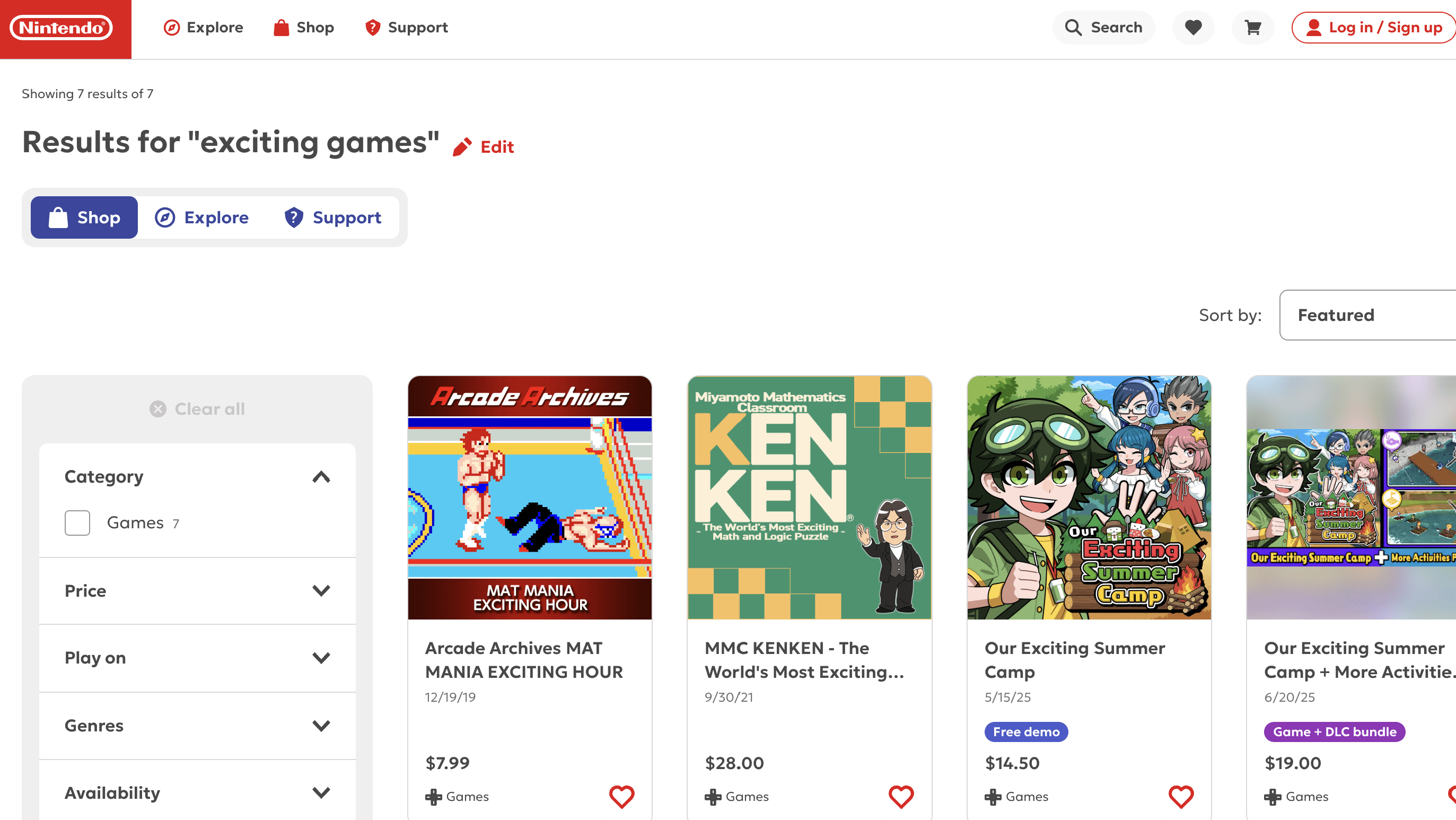
Search "exciting games" on the Nintendo Store today and you get a grand total of 7 results. Amongst them you can find a 1986 arcade boxing game, a math logic puzzle book, a summer camp life-sim, but also NSFW ones. The search results aren't wrong per se: every one of those titles does contain the word "exciting" somewhere in its name. But what we see is that the search engine is merely matching characters, not meaning.
A tempting fix would be to make that search smarter: better relevance ranking, a synonym list, weighting results toward genres like Action or Racing when someone searches a word like "exciting."
That wouldn't really solve it. None of that would change what the system actually knows about a game. It could see the word "exciting" typed into a search box, and the word "Exciting" printed in a title. It would still have no attribute anywhere that says a specific game is fast-paced, high-energy, or tense to play. Ranking better among matches that were never the right matches wouldn't fix that.
There's a structural version of the same problem one level up. Browsing the store leaves a player choosing between two things: a short curated shelf that someone at Nintendo picked, or the entire catalog in release order. One is too narrow to explore, the other too large to sort. The middle ground, where a player describes roughly what they want and gets a useful set back, is missing because nothing in the catalog describes games that way.

Giving mood a place to live
The real fix would be to work on your taxonomy. Giving "exciting" an actual place to live as a game attribute, reconciled across however many ways different publishers describe the same quality whether it's "adrenaline-fueled", "high-energy" or "intense". Based on a more granular, mood-based taxonomy, searching "Exciting Games" would then match your player to games that are actually paced that way, instead of string matching.
What that unlocks is the missing middle ground. Short games, for instance, is not a wish: Gameopedia bands story and campaign length from 1-3 hours up through 100+, so "something we can finish this weekend" becomes a filter rather than a Reddit post. The same applies to cozy and relaxing games, family games, games like one a player already finished. Players have been asking storefronts for these categories for years. Most of them are already fields, just not fields any store has been handed.
Change 2: Filter games by featured characters
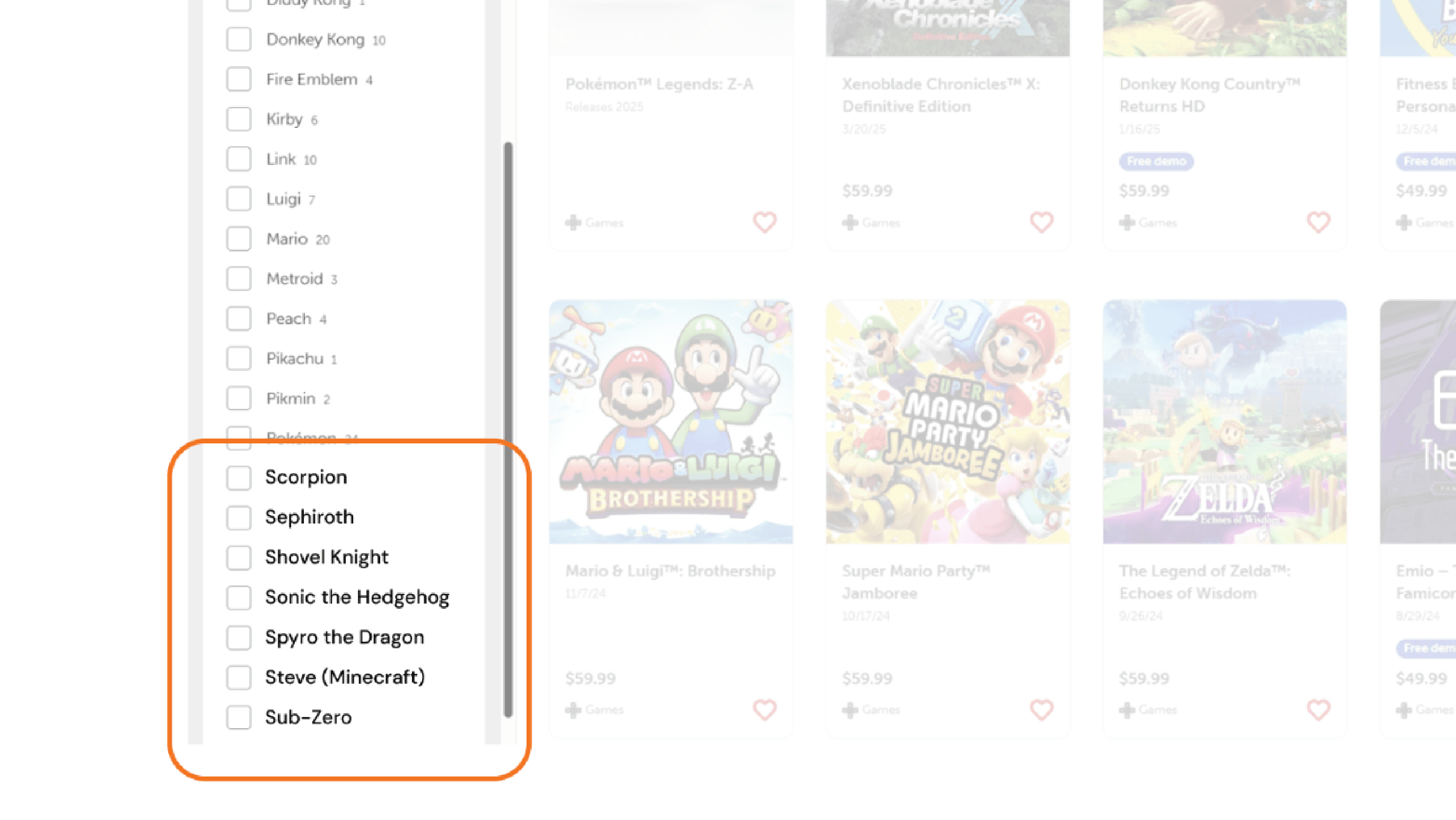
Nintendo's Character filter is a great differentiator from other storefronts but seems to only lists characters Nintendo itself owns. A player browsing by favorite character would find Mario, Link, or Kirby. A well-known character from a third-party Switch title, published by someone else entirely, wouldn't show up, even if the game itself is sitting right there in the catalog.
That's not really a decision about who to exclude. Character data isn't a required field the way genre is. Nintendo fills it in for its own titles because it's Nintendo's own IP to track. A third-party publisher submitting a game has no obligation to tag which character it stars, and most don't bother, so the attribute simply doesn't exist for the vast majority of the catalog.
To fix it, you'd be tempted to just add the missing names to the list. That wouldn't hold for long. A filter built on manually added names would drift out of date the moment a new title shipped, and someone would have to notice the gap and fix it, over and over, forever.

A character as a connection, not a tag
The long-term solution would be to normalize featured game characters and series as an actual taxonomy attribute, populated consistently across every game. Gameopedia Metadata goes a step further than a flat tag: a character gets modeled as a connection across every game and franchise it appears in, down to the specific actor who voiced them. That gets defined once and reused everywhere, instead of retyped from scratch each time a new title ships.
With a more comprehensive filter for characters in place, the search would finally give the player the experience they're looking for: type in a favorite character and find every game they're actually in, beyond what's just convenient for the brand.
Change 3: Filter games by who's actually playing
We can give Nintendo credit here: the filter exists. The games sidebar lets a player narrow their search results by number of players. Plenty of storefronts never get that far.
But there's also what a headcount can't tell you. Two players might mean two people on one couch passing a Joy-Con back and forth. It might mean two people in different locations who each need their own console, their own copy, and a Nintendo Switch Online subscription. Those are different evenings. The store does hold that distinction, but it lives in a separate filter group: Ways to play, where "Meet up and play together", "Online co-op" and "GameShare with local users" sit as options a player has to mentally combine with the player count and hope the two agree.
Neither filter answers the question a parent buying for a Friday night is actually asking, which is whether everyone in the room can play it. Four-player support means very little if the game takes ten hours to become legible to someone who has never really held a controller.
Put all of that together and you get the query a player actually has in their head: two-player local games under twenty dollars that a beginner can pick up. Every term in that sentence is a real attribute. None of them are reachable in one search.


The foundation underneath the fix
None of this works without knowing, first, that a digital release, a physical release, and a remaster are separate things, each with its own record. That's Canonical Identity Resolution, and it's what makes it possible to attach a mode or a player count to one specific edition instead of inferring it from the base game.
On top of that foundation, Gameopedia tracks game modes and player counts as structured attributes in their own right, per mode, per edition, per platform, alongside what each mode actually requires to run: one device or several, one copy or several, a subscription or none. The mode taxonomy goes well past "multiplayer", distinguishing asymmetrical co-op from asynchronous co-op from competitive VS, because those are different evenings too.
Then there's the part no player-count filter has ever covered. Gameopedia scores how steep a game is to get comfortable with. We score complexity separately for controls and for mechanics, against both a casual and a core audience, because a game can be simple to hold and still demand a lot to follow. A player filtering for four players, one console, and a low learning curve would be describing game night precisely. With Gameopedia Metadata, the store would finally be able to answer it.
Change 4: Recommend games that genre filters never connect
Most storefronts recommend the way Nintendo's does today: by what's popular, what's new, and curated collections built around a franchise or a genre shelf. It's a real system, and it works well enough that most catalogs never look past it. It's also fundamentally reactive. It tells a player what other people already bought, not what they'd actually enjoy playing next.
The tempting move is to make that system slightly smarter: better weighting, more editorial picks, tighter franchise collections.


What a genre label can't do
The real opportunity is what a shared genre label can't do: recommend games that look unrelated on the shelf but suit the same player.
Pikmin 2 is filed as a strategy game. A genre-based system would typically send you toward more strategy. But the games a player actually lands on next could be an adventure or a puzzle game. Different genre labels, same kind of fit. Underneath, they share a low learning curve, a cartoonish visual style, and a family-friendly age range. Three of them also share the same tone in Gameopedia's Game Vibes taxonomy: Comedic and Exciting. A system that can read age, skill level, and vibe sees why they belong together.
Structured attributes buy one more thing a popularity ranking can't: a reason. "Because you liked Pikmin 2" is a sentence a store can only write if it knows what Pikmin 2 is.
One signal genuinely isn't Gameopedia's to bring. A player's own history of what they've played belongs to the storefront, not the catalog. But that history is only as useful as what it can be matched against. Knowing a player gravitates toward tense, high-stakes games is worth nothing if "tense" isn't a structured attribute anywhere else in the catalog. The storefront's own signal needs Gameopedia's metadata to have something to land on.
Change 5: Recover from a search for a game you don't carry
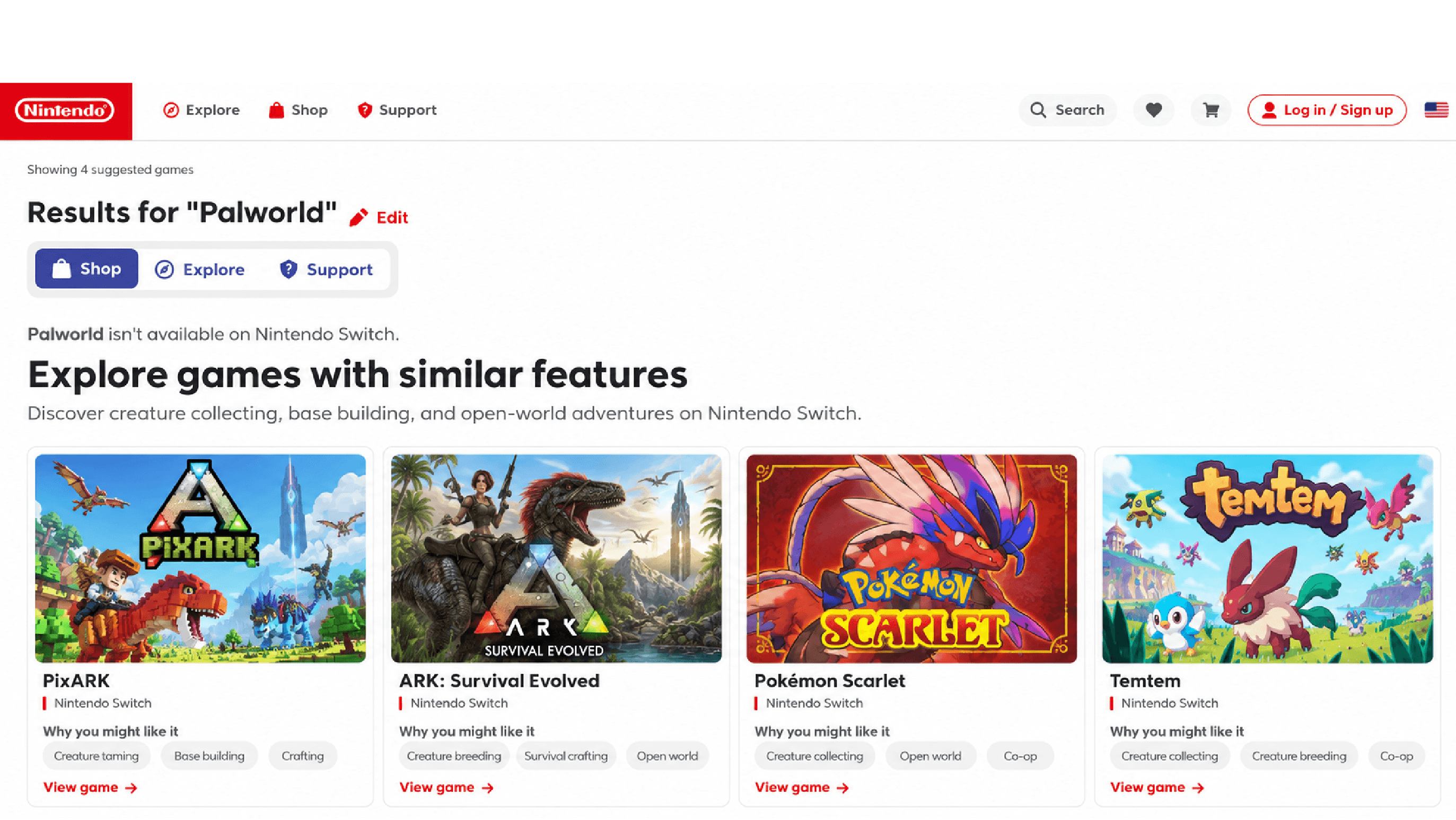
Search the Nintendo Store for Palworld and the page reads: no results found. That answer is correct: Palworld isn't on Switch. But it's also the entire response, from a store that sells at least 80 other creature-collecting games.
Think about who just got turned away. Somebody looking for Palworld wants to catch creatures, breed them, ride them, and put them to work building something, ideally with a friend. That is Nintendo's home turf. The company owns the most successful creature-collecting franchise ever made and sells it on the same storefront that just returned a blank page.
The quick fix would be to fall back on whatever's popular when a search dead-ends. That doesn't help either. Popularity has nothing to do with why someone typed Palworld specifically, and a bestseller shelf can't tell the difference between a player who wants Mario Kart and one who wants to build a base.

Matching on what actually matters
Recovering well means matching on what actually made someone search for that title: the gameplay, the themes, the mechanics, the kind of player it's for.
Run that against the Switch catalog and something interesting falls out. No single game on the platform combines creature collecting with open-world survival crafting the way Palworld does. But both halves are there. ARK: Survival Evolved and PixARK share Palworld's creature breeding, mounts, base building and co-op survival almost attribute for attribute. Pokémon Scarlet and Violet match on every core creature mechanic it has: collecting, capture, breeding, companions, mounts, an open world, co-op.
Nobody had to decide any of that by hand. With structured game metadata, once a catalog knows what Palworld is made of, and knows the same about everything on the shelf, the matches can assemble themselves, including the ones a merchandiser would never have thought to put side by side.
Of the five changes we'd recommend, this is the one with the clearest cost attached. A player who searched for something specific showed up with money and attention already committed. Acquisition spent money to get that player to the search bar on your storefront. The blank page threw it all away.
Bonus: what Nintendo players are actually objecting to
Any conversation about discovery on Nintendo platforms reaches shovelware eventually. Players complain about asset flips, reskins, low-effort releases, AI slop in the new releases list. They have to scroll past games they would never buy to reach the ones they might.
It sounds like a demand for deletion. It mostly isn't. What players actually ask for is narrower: stop putting this in front of me. Keep it in the store, keep it searchable for those you might like it, just don't make me wade through it to find something worth paying for. Nobody is especially keen for a platform holder to start ruling on which small, strange, cheap games deserve to exist, and plenty of good ones would fail that test.
That turns a moderation question into a discovery one, which is worth saying plainly because it marks the edge of what metadata can do. Gameopedia doesn't decide what gets listed on anyone's store. What consistent classification does is give the store something to sort and filter on besides price and release date, and make reskins, clones and near-duplicates visible instead of letting them hide inside a catalog nobody can see the shape of. What gets promoted after that is Nintendo's call. It would just be a call made on structured, trusted game data.shape of. Every ranking decision after that is Nintendo's to make, but at least it would be made on structured, trusted game data.
In short, fix the catalog data to fix the player experience on your storefront
If you read through those five changes as a roadmap for your storefront, you can easily see five new projects: a search rebuild, a filter backfill, a product page redesign, a recommendation model, a fallback behaviour. That's once again five chances to ship something that moves one screen and nothing else for your game discovery strategy and player experience.
They're one project. Every change above needs the same thing first: a catalog that knows what its games actually are, consistently, across every publisher that ever submitted one. Build the mood taxonomy for search and the recommendation rail inherits it. Resolve editions properly and the player-count filter stops contradicting itself. Model characters as connections and both the filter and the dead-end search get better in the same release. The dependency runs one way, and it sits upstream of every screen a player ever touches.
That's also why these problems outlive the teams that inherit them. The complaint always arrives at the interface, so the interface is where the fix gets scoped, and the interface is the one layer where the fix cannot be made. Nintendo could redesign every screen in this article and "exciting games" would still return seven titles with the word in the name.
None of this describes an existing Nintendo project, and none of it belongs to Nintendo alone. Any catalog assembled from hundreds of publishers, or aggregated from several upstream providers, arrives at the same place by a different road.
Most of what your players are looking for is already sitting in your catalog. Talk to our team about making it findable.