


Using Sentiment Analysis For Video Games
Aiman
Sr. Manager - Game Taxonomy
@Gameopedia
Read Time :
4 Min

In the fast-evolving world of video games, understanding how players feel about your game can make the difference between a blockbuster hit and a forgotten title. This article is designed for game developers, marketers, analysts, and anyone interested in the intersection of gaming and player emotions. We’ll explore the concept of sentiment games, a sentiment game is an interactive experience centered on navigating, manipulating, or analyzing emotions and subjective feelings, and how sentiment analysis is transforming the gaming industry. You’ll learn what sentiment games are, why they matter, how sentiment analysis works, and how these tools can be leveraged throughout a game’s lifecycle to improve design, marketing, and player engagement.
A sentiment game is an interactive experience centered on navigating, manipulating, or analyzing emotions and subjective feelings. These games not only entertain but also help players develop the vocabulary to name and differentiate between complex emotions. In this article, we’ll cover the fundamentals of sentiment analysis, its applications in gaming, real-world examples, and practical strategies for integrating sentiment insights into your development and marketing processes.
What exactly is sentiment analysis, and why is it so important? Sentiment analysis is a powerful marketing tool that enables you to understand customer emotions. It detects positive or negative sentiments in text and is used to gauge brand reputation, gain insights on your customers’ needs, and see how your product is being received.
Now, let’s see how these concepts play out in practice. Imagine you’re launching a new game called “Sentiment Quest.” Despite your hard work, the game’s reception in 2024 is lukewarm. You might wonder why your game is failing, but without clear feedback, it’s hard to pinpoint the issues. Sentiment analysis can help you identify whether gameplay mechanics, narrative dissatisfaction, or technical bugs are impacting player sentiment. After release, it also helps you monitor ongoing reception and address concerns post-launch.
In the sections that follow, we’ll dive deeper into what sentiment games are, how sentiment analysis works, and how understanding player emotions can drive better game design and business outcomes.
Using Sentiment Analysis For Video Games
In today’s markets, the customer is at the top of the food chain. There are plenty of products which are your competitors as well as new ones being made. User opinions and reviews make or break a product and one of the industries where this is most apparent is gaming. A badly rated game has a direct correlation with the number of units of it sold. In comparing estimates of sales on Steam to aggregate review score averages, ArsTechnica found that better reviews do generally translate to more sales for games. In addition to user reviews, numerous articles and opinion pieces published across the industry also contribute to shaping public perception and highlighting trends in game popularity. Game Sentiment allows users to explore data on news articles covering popular video games, providing insights into how media coverage influences perception. Notably, the number of articles covering video games began to rise significantly during the COVID-19 lockdowns in 2020, reflecting increased interest and engagement.
Sentiment analysis can be applied to all games, whether they’re successful or not, to improve them. It is a tool that can not only help you possibly fix your game, but by implementing it throughout your products’ lifecycles, you can improve the likelihood of success and overall quality. AI tools scan social media and player reviews to assign "sentiment scores" for games, offering a quantitative measure of public opinion. Similarly, investors use tools like the Crypto Fear & Greed Index to gauge the crowd's mood and predict price movements, drawing a parallel to how sentiment analysis in gaming can inform business and development decisions.
Now that we've established the importance of sentiment analysis in gaming, let's explore how it works and why it matters for your projects.
What is Sentiment Analysis?
Sentiment analysis is a powerful marketing tool that enables you to understand customer emotions. It detects positive or negative sentiments in text and is used to gauge brand reputation, gain insights on your customers’ needs, and see how your product is being received.
Sentiment analysis for video games involves tracking and analyzing real-time audience sentiments right from when a game is announced up till the present day. It uses Natural Language Processing (NLP) and Text Analysis techniques to highlight subjective information from text from your target audiences, including sources such as articles, reviews, and social media posts. A lexicon-based approach involves using predefined dictionaries of words to determine emotional tone. It even anticipates your users’ actions, as users often share their thoughts and opinions online through comments, forums, and social platforms. Sentiment analysis also monitors opinions for each individual aspect of the game ranging from the gameplay and graphics to the story, and more. Understanding what your users think can help you evolve your roadmap as needed to maximise success, and companies can follow audience engagement over time to identify trends and shifts in sentiment.
Some sentiment analysis tools use artificial intelligence, specifically word2vec technology, to calculate word meanings. In word2vec, each word has a measurable semantic distance from another, indicating their level of relatedness. Techniques like this also underpin comprehensive video game taxonomy systems that classify games by mechanics, moods, and vibes. For example, Semantle is a word guessing sentiment game that informs players how semantically similar their guess is to the secret word.
Gameopedia has created a detailed framework which takes the sentiments of not just customers, but also those of critics and influencers to provide a comprehensive view of the industry’s opinion of your game. This framework helps us track sentiments across various individual aspects of a game such as mechanics, audio design, and narrative.
Now that we've explored what sentiment analysis is, let's look at how understanding player emotions impacts game design.
Understanding Player Emotions
Understanding player emotions forms the foundation of effective game design, particularly when targeting meaningful gameplay experiences and sustained player engagement. In today's competitive market, where players demand more than surface-level entertainment, emotional intelligence separates successful titles from forgettable releases and is closely tied to vibe-based game discovery that matches titles to player moods.
Case Study: Sentiment Games and Deck of Memories
Consider Berlin's indie development scene, where Sentiment Games, a studio established by dedicated game design students, developed "Deck of Memories." The game positions players as the final lighthouse keeper, navigating a world constructed from fragmented memories and complex narratives. The design deliberately challenges player assumptions, requiring them to reconstruct story elements and decode underlying meanings within each memory sequence. The development team combines emotional narrative frameworks with proven gameplay mechanics, ensuring consistent player engagement and cognitive investment across sessions.
The lighthouse keeper's emotional arc represents intentional design architecture that enables direct player connection rather than passive consumption. Players encounter structured emotional beats, nostalgia, curiosity, melancholy, that extend engagement beyond individual play sessions. This development approach, supported by institutions like Medienboard Berlin-Brandenburg, demonstrates the industry's recognition that emotional depth drives sustainable game success.
Emotional Mechanics in Minimalist Games
But emotional engagement extends beyond narrative-focused titles. Games like Semantle, a daily word-guessing challenge, prove that emotional mechanics integrate effectively into minimal gameplay systems. By requiring players to identify words through semantic relationships, Semantle leverages discovery satisfaction and pattern recognition, creating reliable daily engagement that builds player retention.
Sentiment games help players develop the vocabulary to name and differentiate between complex emotions.
For developers, particularly those entering the industry or studying game design, systematic analysis of player feedback and emotional responses provides actionable development intelligence. This process allows teams to iterate more effectively, ensuring each release delivers measurable improvements in player satisfaction and engagement metrics. As the industry matures, more studios adopt data-driven development approaches, using sentiment analysis and community feedback to guide development decisions and validate which game mechanics and features drive player engagement.
Players drive this ecosystem through active participation. By documenting experiences, tracking development progress, and providing structured feedback, they influence game evolution directly. Social platforms and online communities streamline developer-player communication, enabling real-time feedback loops and trend identification, especially when enhanced by integrated gaming analytics on community platforms. This ongoing dialogue ensures games continue advancing in complexity, emotional sophistication, and market relevance.
In a landscape where emotional connection increasingly determines game success, understanding player emotions isn't optional, it's fundamental to effective design strategy. Whether exploring the isolated lighthouse keeper's world or solving daily word challenges, games that create lasting impact are those that generate measurable emotional responses that extend beyond the play experience itself.
As we’ve seen, understanding player emotions is crucial for game design. Next, let’s examine how sentiment analysis can directly enhance your game’s emotional appeal and business outcomes.
How Sentiment Analysis Can Help Your Game's Emotional Appeal
Sentiment analysis can not only help you understand what people think about your product but brings way more to the table. When you combine these insights with game content and feature comparison and a customizable comparison engine for evaluating games and features, you can pinpoint which mechanics, themes, or systems resonate most with your audience. When the insights from sentiment analysis are applied to your product roadmap, the benefits are myriad:
Understand player feelings about your product during ideation, development, and post-release.
Support emotion-driven game discovery experiences.
Help players develop the vocabulary to name and differentiate between complex emotions.
Analyze competitor sentiment to identify strengths and weaknesses.
Boost sales and product reputation by implementing insights from analysis.
Track sentiments across individual aspects of a game (e.g., combat, characters).
Improve product and brand recognition with your audience.
Measure advertising success and follow sentiment trends over time.
Assess customer loyalty and satisfaction.
Increase customer retention.
Now that you know how sentiment analysis can enhance your game’s emotional appeal, let’s see how it fits into every stage of the game development lifecycle.
Sentiment Analysis Throughout a Game's Development Lifecycle
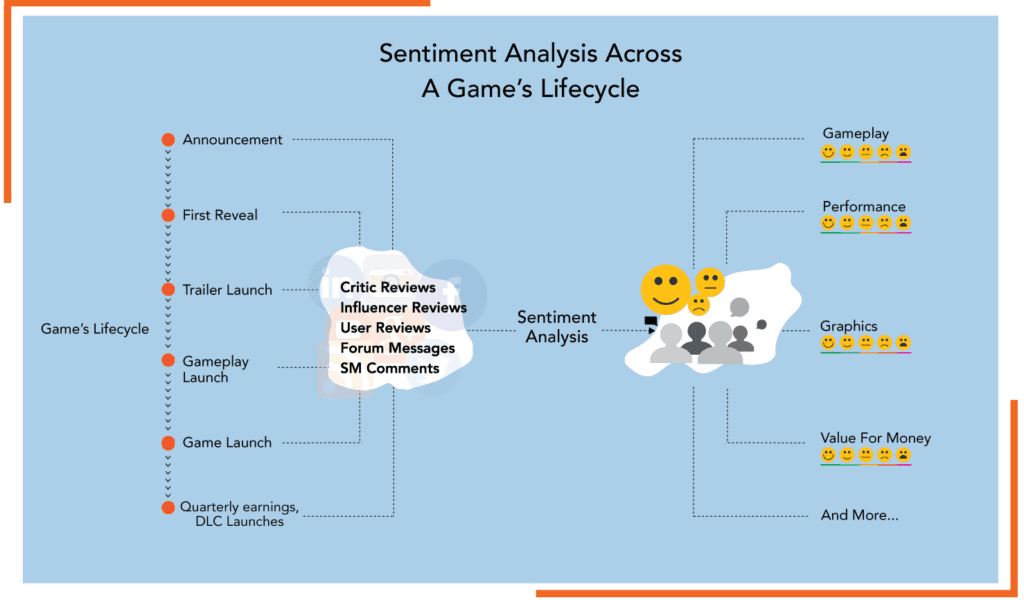
Sentiment analysis is a valuable tool because it can tell you what your audience thinks of your game right from when you announce it till date. This enables you to constantly improve and enhance it based on feedback which can drive up engagement and sales and inform data-driven marketing launch playbooks for your campaigns. Factors such as the quality of gameplay and narrative, how efficiently the game performs, the standard of graphics, the value for money it provides, and more are considered across the game’s lifecycle. Opinions for the aforementioned factors are derived from a variety of places such as critic and influencer reviews, user reviews, posts on social media and forums, articles covering the game, and more. All of these taken into account can make your game significantly better. Let’s take a look at the game lifecycle and how sentiment analysis comes into play.
Planning and Pre-Production
Using sentiment analysis during this stage can help you understand what game to make, what features to include, and ideate better. Competitor analysis is also something which you can do with sentiment analysis to see where your competitors are both winning and lacking and create content on that basis. Many studios rely on in-house systems, proprietary development processes, or AI-powered strategic insight platforms for game marketers to gather and analyze this feedback efficiently, building on holistic game analytics across the development lifecycle.
Announcement
This can tell you whether the general idea of your game as well as the genres/ideas you have for it are received well or not. It can help improve the direction your game goes in.
First Reveal Stage and Trailer Launch
Sentiment analysis here lets you track the buzz about your game on social media and lets you know whether it’s positive. You can also track separate sentiments about your company as well. For instance, response around your game might be mixed but feedback about your company might be positive.
Gameplay Footage Launch
Once you release footage of your game, look for sentiments about your gameplay breakdown. You can find out what your audience is hyped about or hates, be it world and audio design, character abilities, game mechanics, and more. For example, you might introduce a new mechanic called "Dynamic Emotion System" and analyze how players react to it.
Game Launch
You would want to look for sentiments, positive or negative, about the game’s narrative, length, performance, gameplay, graphics, replay value, as well as any bugs or issues which might crop up so you can hot-fix or deal with them. The game is officially released during this stage, and noting the year of release is important for tracking sentiment trends over time.
Post Game Launch
Once you’ve launched your game, you want to know whether your audience feels like it’s good value for money, as well as the overall opinion regarding it. Players are encouraged to share their feedback and follow your updates on social media platforms to stay engaged with ongoing improvements.
Updates/DLC Launches
Here you consider user and critic reviews and ratings apart from sentiments on social media and forums. You want to find out whether your new releases provide your customers with value for money, as well as what they feel about the quality of the releases. Each time new content is released, you can analyze what kind of updates, such as new storylines, features, or bug fixes, are most appreciated by your audience.
With a clear understanding of how sentiment analysis supports each stage of development, let’s see who stands to benefit most from these insights.
Who Sentiment Analysis can Benefit
Stakeholder | How Sentiment Analysis Helps |
|---|---|
Game Developers & Publishers | Identify specific problems and strengths, engage with community feedback, and inform content updates and DLCs. |
E-commerce Portals & Retailers | Gauge pre-launch hype, optimize recommendations, and boost discoverability and conversions with quality metadata. |
Advertisers/Marketers | Optimize campaigns, monitor brand mentions, and design personalized recommendation strategies based on sentiment trends. |
Game Researchers & Analysts | Deepen understanding of player preferences, trends, and genres by combining sentiment data with comprehensive game databases and expert insights. |
Now that you know who can benefit from sentiment analysis, let’s discuss the challenges you might face when implementing these tools.
The Challenges Associated with Sentiment Analysis
The biggest challenge for a sentiment analysis tool is to find technology that can understand nuance. Building a flexible game taxonomy that captures complex features and contexts is equally important for interpreting this data meaningfully. Things which machine learning and NLP might have trouble with are:
Polarity and Context: If you ask a question where you ask for likes and dislikes, even if a user likes your product, they might give sentiments based on whether your question is positive or negative.
Irony and Sarcasm: People can express their negative sentiments using words which are detected as positive by machines. For instance, if someone asks if you like a game you don't, you can be like “Yeah, sure, it was really fantastic <puke smiley>” which technology can have trouble interpreting.
Emojis: When it comes to social media, especially tweets, a lot of them incorporate emojis which can be hard to read and interpret.
Comparisons: Sometimes it can be hard for ML tools to understand whether comparisons being made are positive, negative, or neutral. A statement like “This is better than having nothing, I guess.” can be hard to classify.
Individual Aspect Sentiment Identification: It can be hard to capture the sentiments for individual aspects of a game such as the gameplay mechanics, story, music, and the like.
We fact check our results manually to ensure we capture these nuances perfectly and to train our tool better.
Understanding these challenges is key to choosing the right sentiment analysis approach. Next, let’s look at how Gameopedia’s technology addresses these issues.
Our Technology
Gameopedia's vision for sentiment analysis is a hybrid of Machine Learning (ML) and Natural Language Processing (NLP) technology and human insights. The first two will help pick up on positive and negative keywords in text as our tool analyzes content from social media, forums, reviews, and the like, while the latter can help with nuance and things like sarcasm to make sure our analysis is accurate.
If you require sentiment analysis for your needs, Gameopedia can help you out. We combine the latest in AI, NLP, and human expertise to accurately measure consumer and critic sentiment across user reviews, social media, discussion boards, editorials, web stores, and more. You can also explore Lumos market research and sentiment analysis plans to find a tier that matches your studio’s needs.
30+ years of playing games and following the industry meets 7+ years of taxonomy expertise — Part gamer, Part Gaming Historian.